Disclaimer: This article is for informational and educational purposes only. It does not constitute financial, investment, tax, or legal advice. Investing involves risk, including the possible loss of principal. Always consult a qualified financial advisor before making investment decisions.
What if you could build a powerful, low-maintenance investment portfolio with just two ETFs? The VOO and JEPQ portfolio is one of the most talked-about strategies among US investors in 2026 — and for good reason. It pairs long-term growth with monthly income, making it ideal for both new and experienced investors.
In this guide, you’ll learn exactly how this two-ETF combo works, how to split your allocation, and whether it’s the right fit for your financial goals.
What Is the VOO and JEPQ Portfolio?
The VOO and JEPQ portfolio is a two-fund strategy that combines two powerful ETFs:
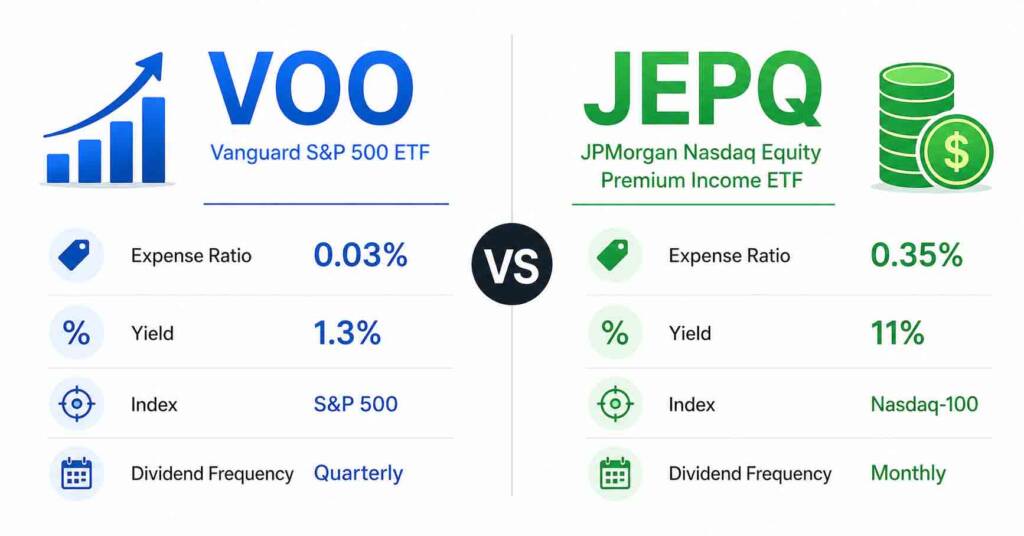
- VOO – the Vanguard S&P 500 ETF, which tracks the 500 largest US companies
- JEPQ – the JPMorgan Nasdaq Equity Premium Income ETF, which provides monthly income through a covered call strategy on Nasdaq-100 stocks
Together, these two ETFs give you broad US market exposure, strong long-term growth potential, and a reliable monthly income stream — all without needing to pick individual stocks.
Breaking Down Each ETF
VOO: The Growth Engine
VOO is managed by Vanguard and holds 500 of America’s largest companies, including Apple, Microsoft, Amazon, and NVIDIA. It carries an ultra-low expense ratio of just 0.03% per year — meaning for every $10,000 invested, you pay only $3 annually in fees.
Over the past 10 years, VOO has delivered a total return of approximately 274%, translating to roughly 14% annualized. That consistent performance is why it has attracted over $800 billion in assets under management.
VOO is the bedrock of this portfolio. It offers diversification across technology, healthcare, financials, consumer goods, and more — all in a single, low-cost fund.
JEPQ: The Income Generator
JEPQ, launched by JPMorgan Asset Management, invests in Nasdaq-100 stocks — names like Apple, Meta, and Alphabet — while also selling call options through equity-linked notes (ELNs) to generate monthly income.
As of April 2026, JEPQ offers a dividend yield of approximately 10.5%–11.5%, paid out every single month. Its expense ratio is 0.35%, which is still very competitive compared to similar income ETFs.
Since its inception, JEPQ has delivered an average annual return of 13.47% including dividends. With over $33 billion in assets, it has become a mainstream choice for income-focused investors.
Why Combine VOO and JEPQ?
Most investors face a classic dilemma: do you prioritize growth or income? The VOO and JEPQ portfolio solves this problem by delivering both.
Here’s what each ETF brings to the table:
| Feature | VOO | JEPQ |
|---|---|---|
| Strategy | Passive index tracking | Active covered call income |
| Benchmark | S&P 500 | Nasdaq-100 |
| Expense Ratio | 0.03% | 0.35% |
| Dividend Yield | ~1.3% | ~10.5%–11.5% |
| Payout Frequency | Quarterly | Monthly |
| Holdings | ~500 stocks | ~99 stocks |
| Best For | Long-term growth | Monthly passive income |
By holding both, you reduce reliance on any single strategy. When markets are volatile, JEPQ’s option premiums can actually increase, boosting your income. Meanwhile, VOO steadily compounds over time through market growth.
How to Allocate Between VOO and JEPQ
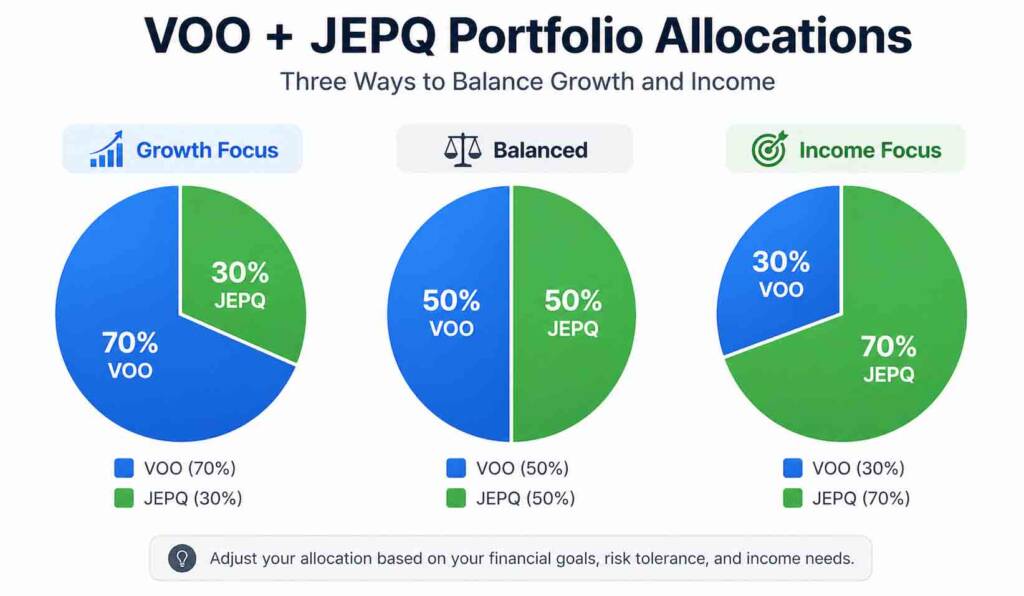
The right split depends on your goals and stage of life. Here are three common allocation strategies:
Growth-Focused Allocation (Younger Investors)
- 70% VOO / 30% JEPQ
- Prioritizes long-term capital appreciation
- Best for investors under 40 with a long time horizon
Balanced Allocation (Mid-Career Investors)
- 50% VOO / 50% JEPQ
- Equal emphasis on growth and income
- Great for investors who want to reinvest dividends while still growing wealth
Income-Focused Allocation (Near Retirement)
- 30% VOO / 70% JEPQ
- Maximizes monthly cash flow
- Ideal for retirees or those approaching financial independence
For example, a $50,000 portfolio with a 50/50 split — $25,000 in VOO and $25,000 in JEPQ — could generate roughly $2,600–$2,875 per year in JEPQ dividends alone based on current yields, plus long-term growth from the VOO side.
Tax Considerations for US Investors
Before you invest, it’s important to understand the tax implications of dividend income.
JEPQ’s monthly distributions are largely classified as ordinary income, not qualified dividends. This means they’re taxed at your regular income tax rate, which can be higher than the 15%–20% qualified dividend rate.
The IRS provides detailed guidance on how dividends and investment income are taxed, which you should review before building an income-heavy portfolio.
To reduce your tax burden, consider holding JEPQ inside a tax-advantaged account like a Roth IRA or traditional IRA. This allows dividends to grow tax-free or tax-deferred. VOO, with its minimal distributions, is generally tax-efficient in any account type.
For more guidance on retirement accounts, the Consumer Financial Protection Bureau (CFPB) offers free resources on retirement accounts and investing basics.
Potential Risks to Know
No investment strategy is without risk. Here’s what to watch for with the VOO and JEPQ portfolio:
- JEPQ caps upside potential — by selling call options, JEPQ may underperform in a fast-rising bull market compared to holding pure Nasdaq-100 stocks
- Yield fluctuations — JEPQ’s dividend yield depends on market volatility; when markets are calm, yields may dip into the 9–10% range
- Tech concentration in JEPQ — with ~99 holdings focused on Nasdaq-100 stocks, JEPQ is more concentrated in technology than VOO
- Market risk — both ETFs can lose value during market downturns, as seen during periods like early 2020
Diversifying your broader financial picture — including maintaining an emergency fund — helps protect your investments during downturns. The Federal Reserve’s consumer finance resources can help you understand the broader economic context of your investing decisions.
Is This Portfolio Right for You?
The VOO and JEPQ portfolio is a strong fit if you:
- Want a simple, low-maintenance investment strategy
- Are looking for monthly passive income alongside growth
- Prefer ETFs over individual stocks
- Have a moderate to long-term investment horizon of 5 or more years
It may not be the best fit if you want pure maximum growth, or if you’re in a high tax bracket and plan to hold these in a taxable brokerage account.
FAQ: VOO and JEPQ Portfolio
Q1: Is the VOO and JEPQ portfolio good for beginners?
Yes. Both are established, well-known ETFs with strong track records. VOO is one of the most recommended beginner ETFs, and JEPQ adds monthly income without requiring you to pick individual stocks. A 70/30 split (VOO/JEPQ) is a great starting point.
Q2: How much monthly income can I earn from JEPQ?
Based on JEPQ’s current yield of approximately 10.5–11.5%, a $10,000 investment could generate roughly $87–$96 per month in dividends. Results vary based on market conditions and yield fluctuations.
Q3: Should I reinvest JEPQ dividends or take the cash?
It depends on your goals. If you’re in the growth phase, reinvesting dividends (DRIP) can accelerate compounding significantly. If you’re in retirement or need consistent cash flow, taking the monthly payout is a perfectly valid strategy.
Q4: Does the VOO and JEPQ portfolio beat the S&P 500?
Not always on pure price appreciation — JEPQ’s covered call strategy limits some upside. However, when you factor in total return including dividends, the combined portfolio competes well, especially in sideways or volatile markets.
Q5: Can I hold this portfolio in a Roth IRA?
Absolutely — and it’s often recommended. Holding JEPQ in a Roth IRA shelters its high ordinary-income dividends from taxes, maximizing your real return. VOO can be held efficiently in either taxable or tax-advantaged accounts.
Start Building Your Two-ETF Portfolio Today
The VOO and JEPQ portfolio offers a rare combination: the long-term compounding power of the S&P 500 paired with consistent monthly income from one of the most popular covered call ETFs on the market. Whether you’re just starting out or looking to simplify your investing strategy, this two-ETF approach is hard to beat for its simplicity and effectiveness.
Ready to take action? Open a brokerage account, decide on your allocation split, and set up automatic contributions. Start small, stay consistent, and let compounding do the heavy lifting over time.