

Most people want to grow their wealth. They research stocks, watch the news, and second-guess every decision — only to watch their scattered picks underperform the very market they were trying to beat. Sound familiar? Here is the hard truth: the majority of professional fund managers fail to beat the S&P 500 over the long term. So why fight it? Instead, you can own the market — efficiently, affordably, and automatically — with a single ETF. The VOO ETF core portfolio strategy is one of the most battle-tested approaches to building lasting wealth in the US stock market.
Key Takeaways:
- VOO tracks the S&P 500, giving you ownership of 518 of America’s largest companies with a rock-bottom 0.03% expense ratio.
- Since its inception in 2010, VOO has delivered an average annual return of 14.87%, making it one of the most powerful long-term wealth tools available to retail investors.
- Making VOO your portfolio’s core holding removes the guesswork, reduces costs, and gives your money the best historical chance of compounding over time.
What Is the VOO ETF?
The Vanguard S&P 500 ETF (ticker: VOO) is a passively managed exchange-traded fund issued by Vanguard that tracks the S&P 500 Index. The S&P 500 represents approximately 500 of the largest publicly traded US companies, chosen by an S&P committee based on market capitalization, liquidity, and financial viability. When you buy one share of VOO, you instantly own a proportional slice of all of them.
VOO was launched on September 7, 2010 and has grown into one of the largest ETFs in the world. As of early May 2026, it manages a staggering $930.55 billion in total assets — a figure that speaks to the trust millions of investors place in it. If you are just starting your investing journey, understanding the basics of ETFs first will help — read our guide on what is ETF investing.
Key VOO Facts at a Glance (May 2026)
Why VOO Belongs at the Core of Your Portfolio
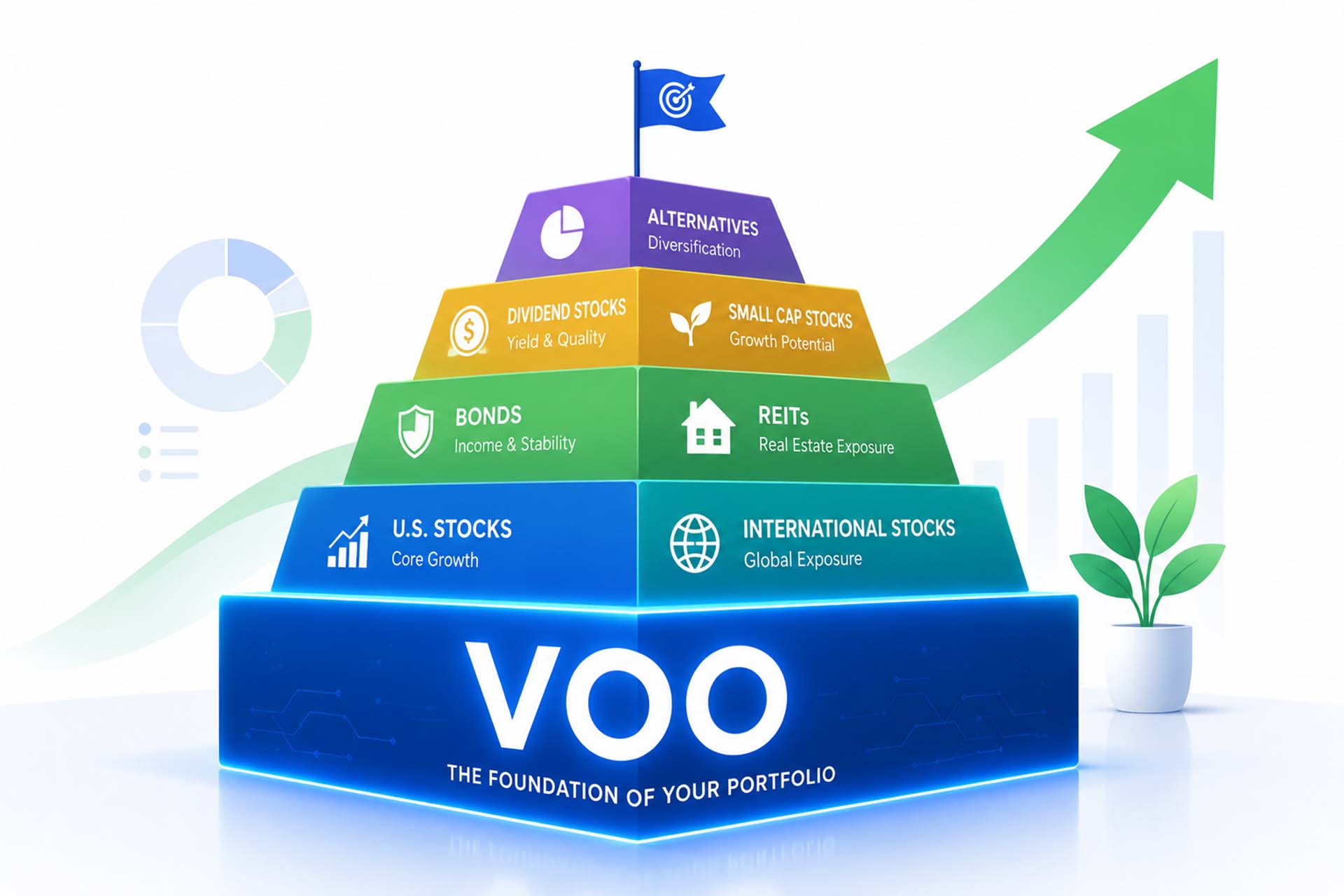
Building a portfolio without a strong core is like constructing a house on sand. The core of your portfolio should be your largest, most stable, and most reliable holding. It must be diversified, low-cost, and aligned with long-term market growth. VOO checks every single one of those boxes.
Unmatched Diversification in One Ticker
When you invest in VOO, you are not betting on one company or one sector. You own a stake in 518 companies spanning technology, healthcare, financials, consumer goods, energy, and more. The top 10 holdings alone include household names like NVIDIA (7.58%), Apple (6.67%), Microsoft (4.92%), Amazon (3.64%), and Alphabet (3.00%). This built-in diversification means that a single company’s failure will not sink your portfolio.
Crucially, this diversification is automatic and self-updating. As the S&P 500 committee adds or removes companies, VOO rebalances accordingly. You always hold the current market leaders without lifting a finger.
An Expense Ratio That Barely Exists
Cost is the silent killer of investment returns. Every dollar paid in fees is a dollar not compounding in your favor. VOO’s expense ratio is just 0.03% per year — meaning you pay only $3 annually for every $10,000 invested. Comparable actively managed mutual funds often charge 0.5% to 1.5%, which can cost you tens of thousands of dollars over a 20-year horizon.
This ultra-low cost structure is one of the primary reasons financial advisors, retirement planners, and individual investors worldwide make VOO the bedrock of their portfolios. [External Link: Vanguard’s official VOO profile]
Consistent Long-Term Performance
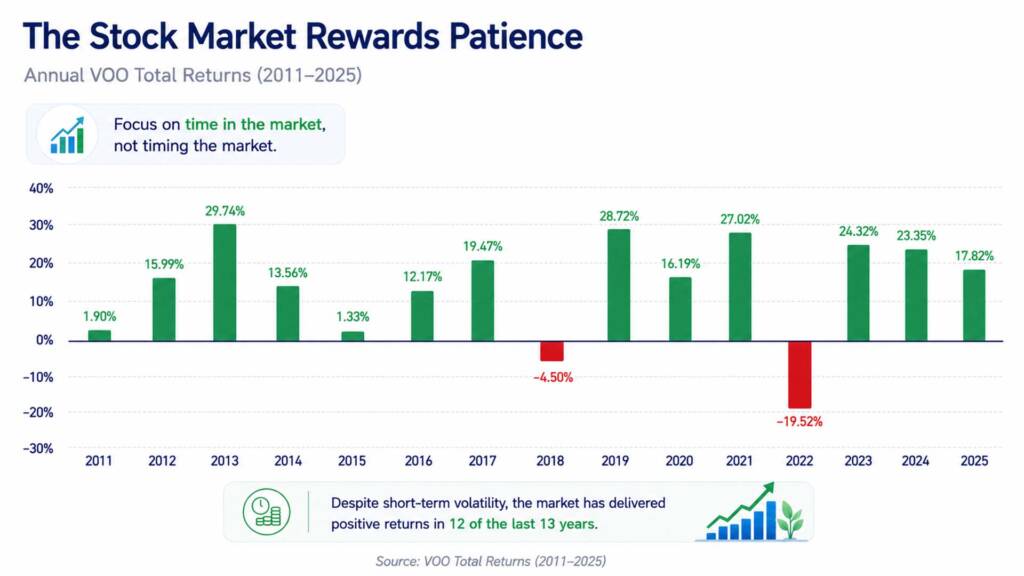
The historical data is compelling. Here is VOO’s recent annual return track record:
- 2024: +23.35%
- 2023: +24.32%
- 2022: -19.52% (market-wide bear market)
- 2021: +27.02%
- 2020: +16.19%
- 2019: +28.72%
- 2017: +19.47%
- 2013: +29.74%
The key takeaway is the pattern — not any single year. Even after the brutal -19.52% drop in 2022, VOO recovered strongly, delivering +24.32% in 2023 and +23.35% in 2024. In fact, the 1-year total return through early 2026 stands at an impressive +31.81%. Long-term investors who stayed the course were richly rewarded.
The Power of Compounding: A Real-World VOO Simulation
Numbers come alive when you see what consistent investing actually produces. Using VOO’s historical average annual return of 14.87% since inception, here is what a monthly investment could realistically grow to. (Note: These are projected outcomes based on historical performance. Past results do not guarantee future returns.)
Scenario: Investing $200/Month in VOO
| Time Horizon | Total Contributed | Projected Value (at ~10% conservative avg.) | Projected Value (at ~14.87% historical avg.) |
|---|---|---|---|
| 5 Years | $12,000 | ~$15,487 | ~$17,200 |
| 10 Years | $24,000 | ~$38,284 | ~$50,600 |
| 20 Years | $48,000 | ~$151,873 | ~$290,000 |
| 30 Years | $72,000 | ~$452,098 | ~$1,400,000+ |
Even at a conservative 10% annual return — below VOO’s historical average — investing just $200 per month grows to over $450,000 in 30 years. The mathematical force at work here is compound growth: your returns earn their own returns, accelerating exponentially with time.
If you want to start even smaller, we break down exactly how to do it in our article on investing $50 a month in VOO.
The Key: Starting Early and Staying Consistent
Time in the market consistently outperforms timing the market. A 25-year-old who begins investing in VOO today has a fundamentally different compounding runway than someone who starts at 40. Furthermore, dollar-cost averaging — investing a fixed amount regularly regardless of price — smooths out volatility and removes the emotional burden of trying to pick the perfect entry point.
How to Build a VOO ETF Core Portfolio
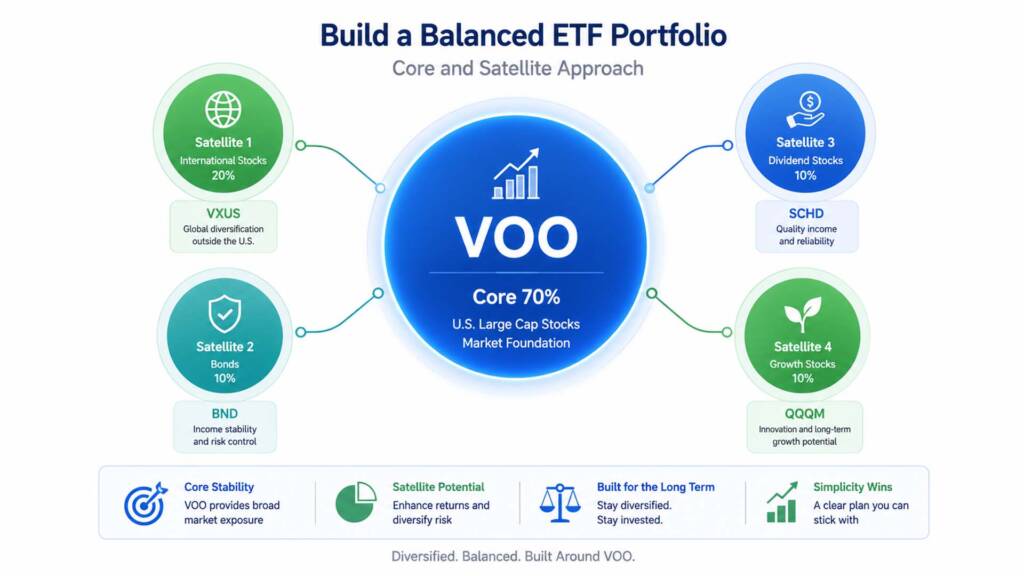
Making VOO your core means allocating the largest portion of your equity exposure to it. A popular and well-regarded framework is the Core-Satellite Strategy.
The Core-Satellite Framework
- Core (60–80% of portfolio): VOO — broad US large-cap exposure, low cost, self-diversifying
- Satellite Holdings (20–40%): Complementary ETFs for growth, income, or international diversification
This approach keeps your portfolio anchored by stability while allowing you to pursue additional growth or income goals with a smaller allocation. For example, pairing VOO with an income-generating ETF can balance capital appreciation with cash flow — explore how this works in our VOO and JEPQ portfolio guide.
Sample Core-Satellite Portfolio for Beginners
| Allocation | ETF | Purpose |
|---|---|---|
| 70% | VOO | US large-cap core, S&P 500 exposure |
| 15% | VXUS or IEFA | International diversification |
| 10% | BND or AGG | Bond stability, reduced volatility |
| 5% | SCHD or JEPQ | Dividend income |
This simple four-ETF portfolio covers the US market, international stocks, bonds, and income — all built around VOO as the foundation.
Avoid Common Mistakes
Many beginners over-complicate their portfolios or make emotionally driven decisions during market downturns. These errors consistently destroy long-term returns. Learn how to sidestep the most damaging behaviors in our post on beginner investor mistakes.
VOO vs. Other Popular S&P 500 ETFs
VOO is not the only S&P 500 ETF, but it is arguably the best for most long-term investors. Here is how it compares to its closest rivals:
| Feature | VOO (Vanguard) | SPY (State Street) | IVV (iShares) |
|---|---|---|---|
| Expense Ratio | 0.03% | 0.0945% | 0.03% |
| Assets Under Management | ~$930B | ~$600B+ | ~$600B+ |
| Index Tracked | S&P 500 | S&P 500 | S&P 500 |
| Dividend Reinvestment | Efficient | Less efficient | Efficient |
| Best For | Long-term investors | Active traders | Long-term investors |
VOO and IVV are essentially tied on expense ratio, but Vanguard’s ownership structure — where the funds own the company — aligns the firm’s interests with investors in a uniquely powerful way.
Also consider: if you prefer even broader US market exposure beyond large-caps, VTI (Vanguard Total Stock Market ETF) includes over 3,600 companies at the same 0.03% expense ratio. Understanding the difference between growth-focused and dividend-focused ETFs is equally important — see our guide on growth vs. dividend investing.
VOO in 2026: What the Current Market Tells Us
As of May 2026, VOO is trading near its 52-week high of $675.34, signaling strong market momentum. The S&P 500 has posted five consecutive weeks of gains, reaching new all-time highs, driven largely by strong Big Tech earnings and improving investor sentiment. JPMorgan recently raised its year-end S&P 500 target to 7,600, citing stronger AI earnings and improved market resilience.
Year-to-date in 2026, the ETF is slightly negative (-4.72%) through the early months, which is a normal occurrence in any given year and simply reflects the market’s natural fluctuation. The 1-year total return through this period remains an outstanding +31.81%, reinforcing that short-term noise is largely irrelevant for long-term VOO investors.
Conclusion & Call to Action
The case for making VOO the core of your investment portfolio is clear, data-backed, and time-tested. With an ultra-low 0.03% expense ratio, $930 billion in assets, an average annual return of 14.87% since inception, and instant access to 518 of America’s most powerful companies, VOO is not just an investment choice — it is a strategy. It removes complexity, reduces costs, and lets compound growth do the heavy lifting over time.
The best time to start was yesterday. The second-best time is today.
Have you already included VOO in your portfolio? Leave a comment below and let us know how you structure your core holdings — we’d love to hear from our community! And if you want to see exactly what a VOO-anchored portfolio looks like in practice, check out our detailed breakdown of a VOO and JEPQ portfolio strategy.
FAQs
Q1: Is the VOO ETF a good core holding for a long-term portfolio?
Yes. VOO’s ultra-low cost (0.03%), broad diversification across 518 companies, and a historical average annual return of 14.87% since inception make it one of the strongest core holdings for long-term investors targeting US market growth.
Q2: How much should I invest in VOO each month as a beginner?
Even $50–$200 per month consistently invested in VOO can build substantial wealth over time through the power of compounding. At a conservative 10% average annual return, $200/month grows to over $150,000 in 20 years and $450,000+ in 30 years. Start with whatever amount you can commit to consistently.
Q3: What is the difference between VOO, SPY, and IVV?
All three track the S&P 500, but VOO and IVV have the lowest expense ratio at 0.03%, versus SPY’s 0.0945%. SPY is preferred by active traders due to its high liquidity, while VOO is generally recommended for long-term, buy-and-hold investors due to Vanguard’s investor-first ownership structure.
Financial Disclaimer
This article is intended for educational and informational purposes only. It does not constitute personalized financial, investment, or tax advice. All investment strategies involve risk, including the possible loss of principal. Historical returns referenced in this article are not guarantees of future performance. Projected outcomes are based on historical averages and are for illustrative purposes only. Always conduct your own research and consult with a qualified financial advisor before making any investment decisions.
