

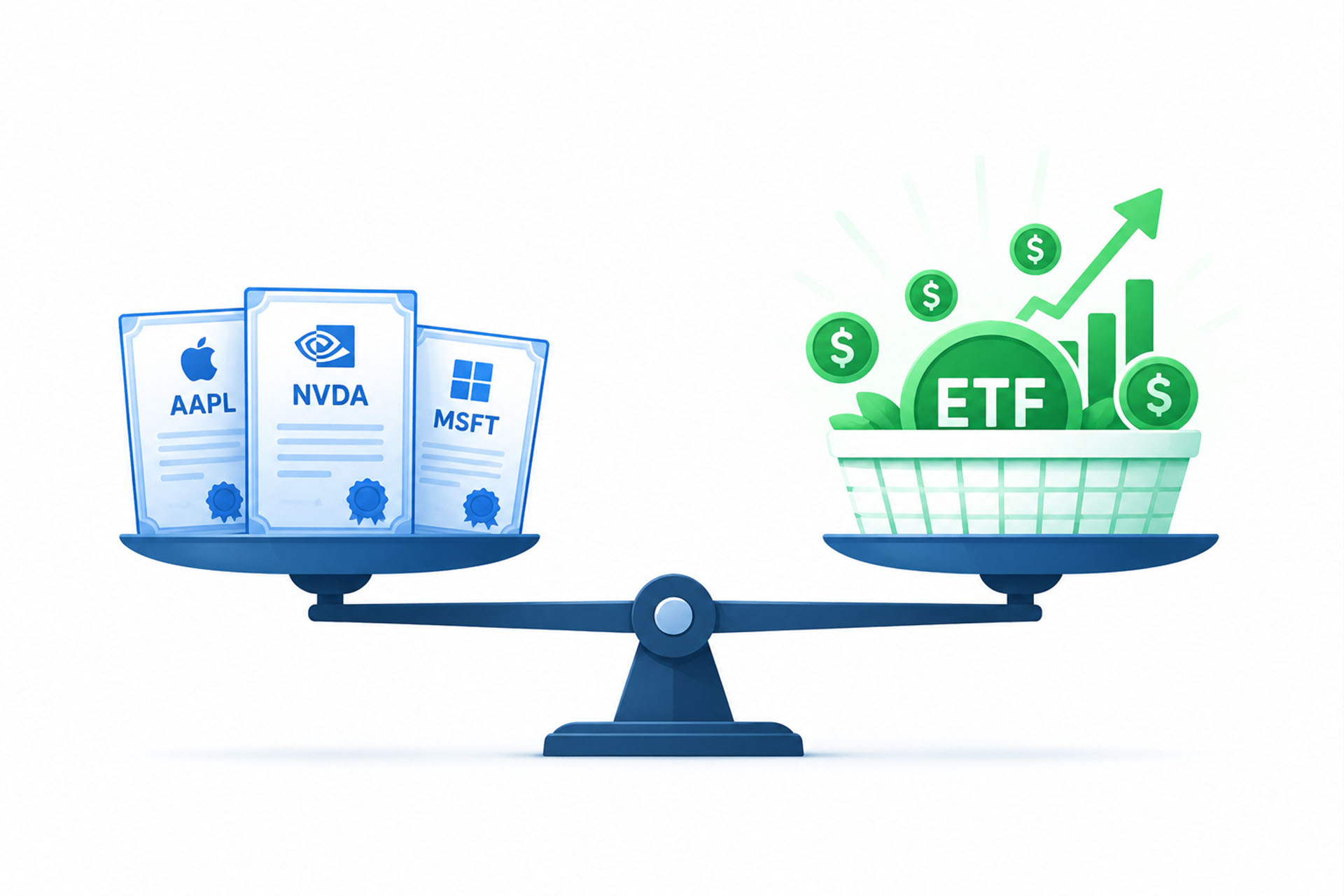
You want to build real, lasting wealth in the US stock market. But every time you sit down to invest, the same question stops you cold: Should I pick individual stocks or just buy an ETF? The wrong choice here isn’t just uncomfortable — it can cost you decades of compounding growth. Miss on a single stock bet, and you could watch years of savings evaporate in one earnings call. The good news? There is a smarter, data-backed way to think about this decision — and by the end of this article, you’ll know exactly where your money belongs.
Key Takeaways:
- Broad-market ETFs like VOO have delivered a ~10.24% compound annual return over the past 30 years, making them the most reliable core holding for long-term investors.
- Individual stocks offer explosive upside — but over 80% of actively managed funds and most retail stock-pickers fail to consistently beat the S&P 500 over 10+ years.
- For most beginners and intermediate investors, the most powerful strategy combines a core ETF position (60–70%) with a small, deliberate individual stock allocation for growth potential.
What Are Stocks and ETFs, Really?
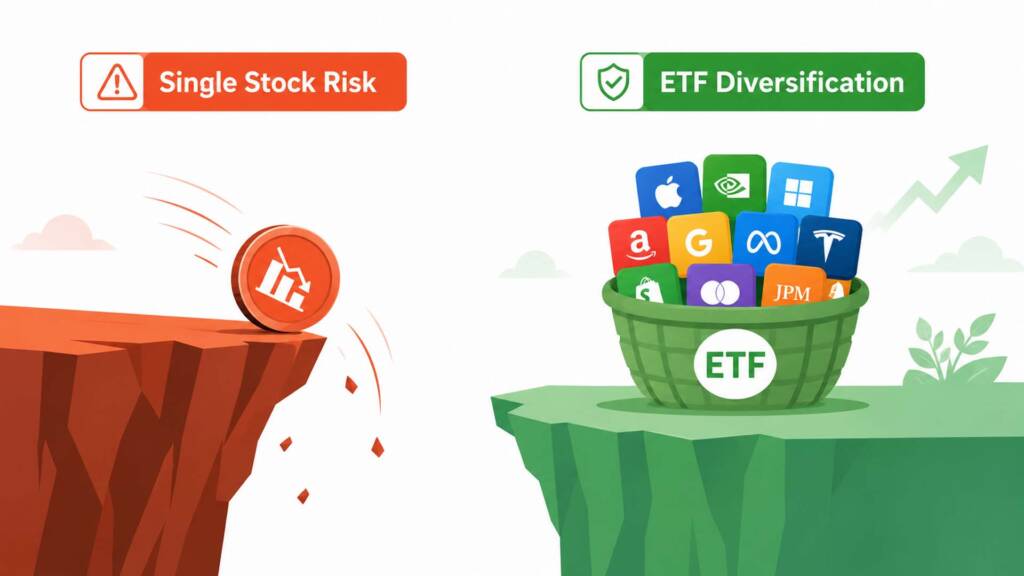
Before diving into the debate, it helps to understand what you’re actually buying. When you purchase an individual stock, you’re buying a fractional ownership stake in a single company — its profits, its risks, and its future. When you buy an ETF (Exchange-Traded Fund), you’re buying a single share that holds a basket of many securities, often tracking an index like the S&P 500.
ETFs trade on exchanges just like stocks, so you can buy and sell them throughout the trading day. The critical difference is that one bad quarter at one company won’t sink your entire ETF position — because you’re spread across hundreds of holdings at once. To get a solid foundation on how ETFs work mechanically, check out our deep-dive guide: What Is ETF Investing?
The Core Difference: Risk vs. Reward
This is where the debate gets interesting — and where many investors make costly mistakes.
Individual Stocks: The High-Ceiling, High-Floor Bet
Individual stocks can deliver extraordinary returns. In 2025, for example, Micron Technology (MU) surged 224%, Robinhood Markets (HOOD) climbed over 200%, and Western Digital (WDC) posted gains of 154–304% — all fueled by AI infrastructure demand and sector tailwinds. Those are life-changing returns if you’re positioned correctly.
However, for every Micron, there are dozens of stocks that went sideways or collapsed. The challenge is that picking winners consistently requires deep research, sector expertise, earnings analysis, and strong emotional discipline. Most retail investors, especially beginners, lack the time or tools to do this reliably — and the data is unforgiving.
ETFs: The Steady, Compounding Machine
ETFs trade the ceiling for consistency. The S&P 500, tracked by funds like VOO, has delivered an average total annual return of approximately 10.4% over 30 years when dividends are reinvested. In the last decade specifically, that figure rose to 15.5% per year including dividends — thanks to a historic bull run in tech and innovation stocks.
Here are VOO’s actual annual returns in recent years, giving you a sense of the real-world ride:
| Year | VOO Annual Return |
|---|---|
| 2025 | +16.39% |
| 2024 | +23.35% |
| 2023 | +24.32% |
| 2022 | –19.52% |
| 2021 | +27.02% |
| 2020 | +16.19% |
Notice how even the down year (2022) was followed by two exceptional years. That’s the power of staying invested in a diversified ETF through volatility.
The Math That Changes Everything: Compounding Simulation
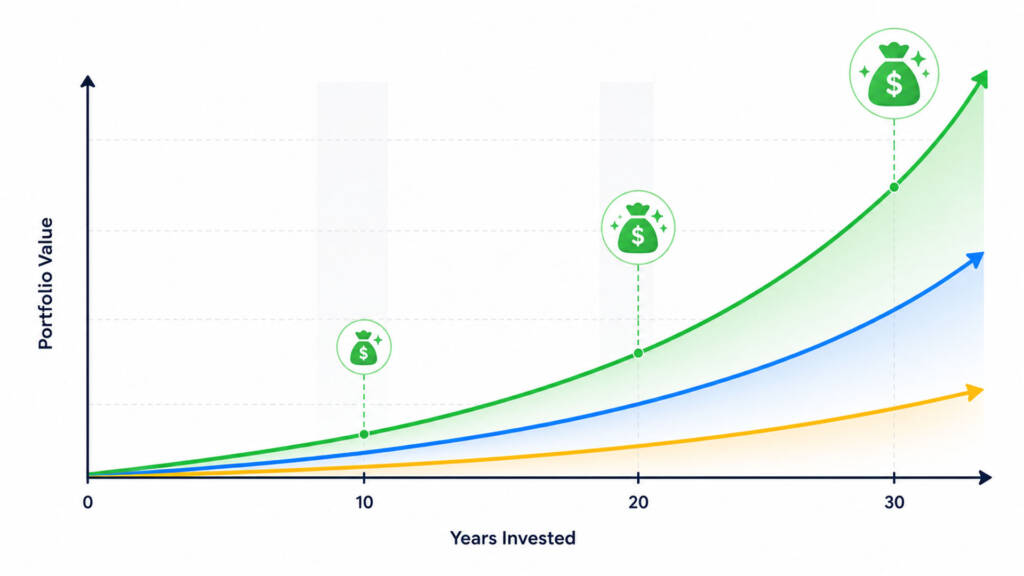
Let’s put real numbers to work. This is one of the most important things a long-term investor can understand. Assume you invest $300 per month consistently into VOO, using a conservative historical rate of 10% annual return (the 30-year average).
| Years Invested | Total Contributed | Projected Value |
|---|---|---|
| 10 years | $36,000 | ~$61,453 |
| 20 years | $72,000 | ~$206,284 |
| 30 years | $108,000 | ~$598,253 |
Based on historical S&P 500 average returns. Past performance does not guarantee future results.
By year 30, your $108,000 in contributions has grown to nearly $600,000 — without picking a single stock. The multiplier effect of time and consistent investing is the single most powerful tool in a long-term investor’s arsenal. To see how even $50 per month in VOO compounds over time, read our practical guide: Investing $50 a Month in VOO
Why Most Stock Pickers Underperform the Index
Here’s a hard truth that Wall Street doesn’t advertise: the vast majority of professional fund managers fail to beat the S&P 500 consistently over 10+ years. If paid professionals with Bloomberg terminals and research teams can’t do it, what does that mean for the individual investor?
It means that trying to outperform the market through stock picking comes with enormous risk and requires enormous skill. ETFs, by design, deliver the market’s return — and that’s actually more than most investors ever achieve, because they buy high, sell low, and let emotion drive their decisions.
That said, individual stocks aren’t without merit. They reward patience and deep research. If you have genuine conviction in a company’s fundamentals — and you’re prepared to hold for 5–10 years — a small allocation to individual stocks can be a powerful complement to your ETF core.
Stocks vs. ETFs Long Term: A Side-by-Side Breakdown
When you’re thinking about stocks vs ETFs long term, it helps to compare them across the dimensions that matter most to a wealth-building strategy.
| Dimension | Individual Stocks | Broad-Market ETFs (e.g., VOO) |
|---|---|---|
| Diversification | Low (single company risk) | High (500+ holdings in VOO) |
| Potential Return | Unlimited upside possible | Tracks market average (~10% historical) |
| Risk Level | High — one bad event = major loss | Moderate — market-wide downturns only |
| Time Required | High — research, monitoring | Very Low — set and forget |
| Fees | Brokerage commissions | Very low (VOO expense ratio: 0.03%) |
| Emotional Difficulty | High | Low |
| Best For | Experienced, research-driven investors | Beginners to advanced long-term investors |
The 0.03% expense ratio on VOO means that for every $10,000 invested, you pay just $3 per year in fees. That’s virtually nothing compared to the value delivered.
The Hybrid Strategy: Best of Both Worlds
The smartest long-term investors don’t view this as an either/or question. Instead, they build a core-and-satellite portfolio structure. Here’s how it works in practice:
- Core (60–70%): Broad-market ETFs like VOO (S&P 500) or QQQM (Nasdaq-100 growth). These are your compounding engines.
- Growth Boost (15–20%): Sector ETFs like SMH (semiconductors) or SCHG (US large-cap growth) for targeted upside.
- Individual Stocks (10–15%): High-conviction picks where you have genuine research and a long time horizon. Companies like NVDA or MU in the AI/semiconductor space, for example.
- Income Layer (5–10%): Dividend-focused ETFs like SCHD or JEPQ for cash flow while you hold.
This structure gives you the stability and compounding power of ETFs while preserving the ability to capture individual stock upside. For a real-world example of this approach in action, see our portfolio breakdown: VOO and JEPQ Portfolio Strategy
Understanding the difference between growth and dividend investing is also key to deciding how to split your satellite positions — explore that in our article: Growth vs. Dividend Investing
Common Mistakes to Avoid
Whether you choose stocks, ETFs, or both, certain traps destroy long-term wealth at an alarming rate. Here are the ones to watch out for:
- Timing the market instead of staying invested through volatility — missing just the 10 best trading days in a decade can cut your returns nearly in half.
- Over-concentrating in a single stock or sector, thinking you’ve found “the next big thing.”
- Selling during downturns — VOO dropped 19.52% in 2022, then gained 24.32% and 23.35% in the two years that followed. Panic sellers locked in losses and missed the recovery.
- Ignoring fees — a 1% annual fee difference, compounded over 30 years, costs you tens of thousands in lost growth.
- Starting too late — time in the market is the single most powerful variable in compounding wealth.
Want a full breakdown of the errors new investors make? Our guide on Beginner Investor Mistakes covers exactly that.
What Does 2026 Tell Us About the Long Game?
As of May 2026, VOO is trading at approximately $678–$688 per share, with a 1-year price return of +30.56% — a remarkable run despite short-term volatility earlier in the year. The S&P 500 delivered +25.02% in 2024 and +17.88% in 2025 (total return, including dividends).
However, some analysts caution that forward returns may moderate from recent highs. Goldman Sachs and other major strategists project S&P 500 returns may normalize closer to the 30-year average of ~10% annually in the years ahead. This makes a consistent, dollar-cost-averaging approach into diversified ETFs even more critical — because capturing average market returns reliably is still a superior outcome for most long-term investors.
The takeaway for 2026? Don’t let short-term headlines distract you from a multi-decade wealth-building plan anchored in broad-market ETFs.
Conclusion & Call to Action
The stocks vs ETFs long term debate doesn’t have a single winner — it has a smarter framework. For most investors, especially those building wealth over 10, 20, or 30 years, broad-market ETFs like VOO are the unbeatable core holding: low cost, diversified, and historically proven to compound wealth reliably. Individual stocks can play a valuable satellite role — but only when backed by genuine research and conviction, not speculation or emotion.
Start with a strong ETF core. Add individual stocks only when you truly understand what you own. Keep fees low, reinvest dividends, and let time do the heavy lifting.
What’s your current strategy — ETFs, individual stocks, or a hybrid mix? Drop your approach in the comments below — we’d love to hear what’s working for you. And if you’re just getting started, don’t miss our beginner-friendly article on building a VOO ETF core portfolio to put today’s insights into action.
For additional reading, Vanguard’s own investor education center at Vanguard.com and Investopedia’s ETF vs. Stock Guide offer excellent, well-sourced overviews.
Frequently Asked Questions
Q1: Are ETFs safer than individual stocks for long-term investing?
A1: Generally, yes. ETFs spread your investment across hundreds of companies, which reduces the impact of any single company failing. Broad-market ETFs like VOO have shown far less volatility per unit of return than most individual stocks over 10+ year periods. However, ETFs still carry market risk — they will decline during broad downturns. The key is staying invested through those periods rather than selling at a loss.
Q2: Can individual stocks outperform ETFs in the long term?
A2: Absolutely — but it’s rare and difficult to achieve consistently. In 2025, stocks like MU surged 224% and WDC gained over 154%, far outpacing the S&P 500’s 16–17% return. However, correctly identifying those winners in advance requires deep research, patience, and significant risk tolerance. For every multi-bagger stock, many others underperform or go to zero.
Q3: What is the best ETF to hold for long-term wealth building in 2026?
A3: VOO (Vanguard S&P 500 ETF) remains the gold standard for most long-term investors. It tracks the S&P 500 with a microscopic 0.03% expense ratio and has delivered a 10.24% compound annual return over the past 30 years as of April 2026. For growth-oriented investors, pairing VOO with QQQM or SCHG adds additional upside exposure to high-growth sectors.
Financial Disclaimer: This article is for educational and informational purposes only. The content presented here, including data, compounding simulations, and investment strategies, does not constitute personalized financial advice, and past performance of any investment does not guarantee future results. All investing involves risk, including the possible loss of principal. Always conduct your own due diligence and consult with a licensed financial advisor before making any investment decisions.
