You did everything right. You opened a US brokerage account, skipped the expensive local funds, and built a low-cost core position in the Vanguard S&P 500 ETF. Your expense ratio is 0.03%. Your diversification is excellent. Your discipline is better than most.
Then someone in a forum mentions the VOO estate tax problem, and you discover that if you die holding more than $60,000 of US-listed assets, your family could owe the IRS a six-figure bill — and may wait a year or more before your broker releases a single share.
That is not a scare story. It is a real, documented feature of the US tax code that applies specifically to non-US investors, and most brokers will never mention it to you. The good news: the exposure is easy to measure, and the fix is a single structural decision you can make in an afternoon.
Key Takeaways:
- VOO is an excellent fund with a structural problem for non-US investors — the risk is legal, not investment-related. US-listed ETFs are US-situs assets, so anything above a $60,000 threshold is exposed to estate tax rates that climb from 18% to 40%.
- Your broker’s location does not change the answer. Holding VOO through a non-US brokerage still leaves you exposed, because the IRS looks at where the asset is domiciled, not where your account sits.
- For investors from countries without a US estate tax treaty, an Irish-domiciled S&P 500 UCITS ETF often costs less per year than VOO after withholding tax — meaning the estate protection can be effectively free.
First, Let’s Separate Two Very Different Questions
“Is VOO safe?” bundles together two things that deserve separate answers.
As an investment, VOO is about as solid as a single fund gets. It tracks the S&P 500 at a 0.03% expense ratio, and Vanguard’s advisor platform listed total net assets of roughly $979 billion with a 10.4% year-to-date return as of July 2026. Shares traded around $687.87 on July 22, 2026 (per Investing.com), with a dividend yield reported between 1.06% and 1.14% depending on the source. That spread is not an error — trailing twelve-month yields differ from forward annualized yields, and providers use different price dates.
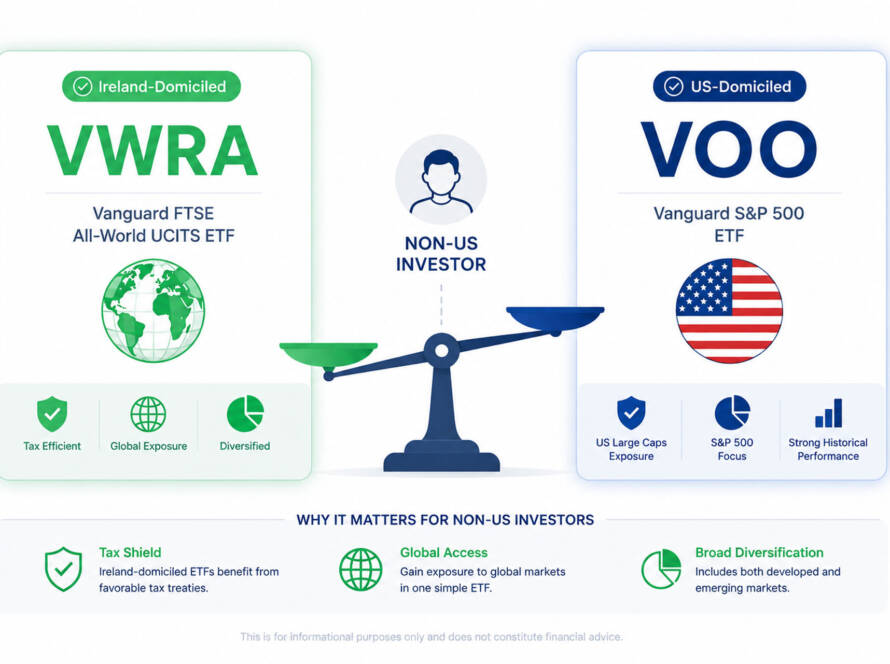
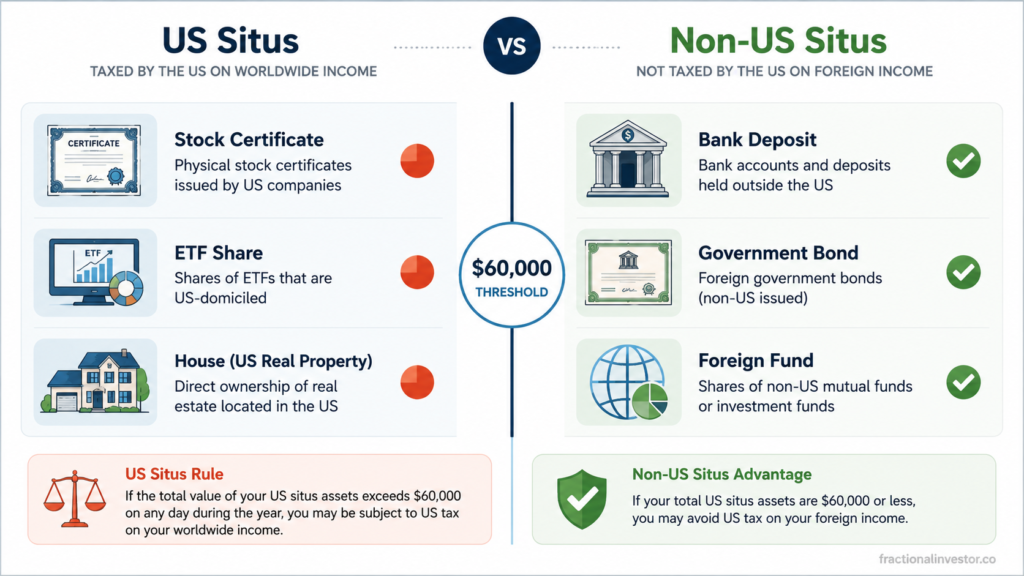
As a structure, VOO carries a risk that has nothing to do with markets. It is a US-domiciled fund, which makes every share you own a US-situs asset in the eyes of the IRS. That single fact drives everything below.
This distinction matters because the answer is not “sell VOO.” For many investors, the answer is “keep the exposure, change the wrapper.” We cover the underlying investment case in our VOO core portfolio guide; this article is strictly about the structural layer sitting on top of it.
The VOO Estate Tax Rule Most International Investors Miss
Here is the asymmetry at the heart of it.
A US citizen or US-domiciled individual receives a unified estate and gift tax exemption of $15 million for 2026, indexed for inflation going forward. A non-US-domiciled individual — a nonresident alien, or NRA — receives an exemption of just $60,000 on US-situs assets. That figure is not indexed for inflation and has been unchanged for decades.
Mechanically, the IRS grants NRAs a unified credit of $13,000, which happens to be exactly the tax due on a $60,000 taxable estate under the standard rate schedule. Above that, the graduated rates in Table A of the Form 706 instructions apply, running from 18% up to a top marginal rate of 40%.
Three procedural details matter as much as the rate:
- Filing is triggered at $60,000, not at the point tax is owed. The IRS requires an executor to file Form 706-NA when the date-of-death value of US-situated assets, plus the gift tax specific exemption and adjusted taxable gifts, exceeds the $60,000 threshold.
- The deadline is nine months from death, with an automatic six-month extension available on Form 4768 — but the extension covers filing only, not payment.
- Your heirs may not be able to touch the account until the IRS signs off. A Transfer Certificate (Form 5173) is issued once the estate tax has been fully discharged or provided for, and US financial institutions generally will not release the assets without it. Complete packages commonly take 12 to 18 months from receipt.
That last point is the one that surprises people. Even a fully-paid, treaty-protected estate can leave a grieving family locked out of a brokerage account for a year while markets move.
Where Your Broker Sits Does Not Save You
A persistent myth holds that using a non-US broker keeps you outside the net. It does not. Situs attaches to the asset, not to the account.
Interactive Brokers has publicly confirmed the granularity here: US stocks, US-domiciled ETFs, and US bonds held at its Irish entity are still US-situs assets. Interestingly, the same source notes that USD cash held at IBKR Ireland is not US-situs, while USD cash at IBKR UK is — a reminder that these rules are technical and entity-specific.
What Counts as US Situs — and What Surprisingly Doesn’t
The definition is counterintuitive enough that even careful investors get it wrong.
| Asset | US situs for estate tax? |
|---|---|
| US-listed ETFs (VOO, QQQ, SCHD) | Yes |
| Shares in US corporations | Yes |
| US mutual funds and money market funds | Yes |
| Cash deposits held with a US broker | Yes (IRC § 2104(c)) |
| US real estate | Yes |
| Deposits in a US bank (checking, savings, CDs) | No |
| US Treasury bonds and qualifying “portfolio debt” | No (IRC § 2105(b)) |
| Irish or Luxembourg-domiciled UCITS ETFs | No |
Two things stand out. First, a bank deposit is excluded but a brokerage cash balance is not — the ACTEC Foundation makes this distinction explicitly. Second, a Treasury bond held directly escapes estate tax, but the same bond wrapped inside a US-listed bond ETF does not. The wrapper strips the exemption.
The Real Numbers: What a VOO Position Could Cost
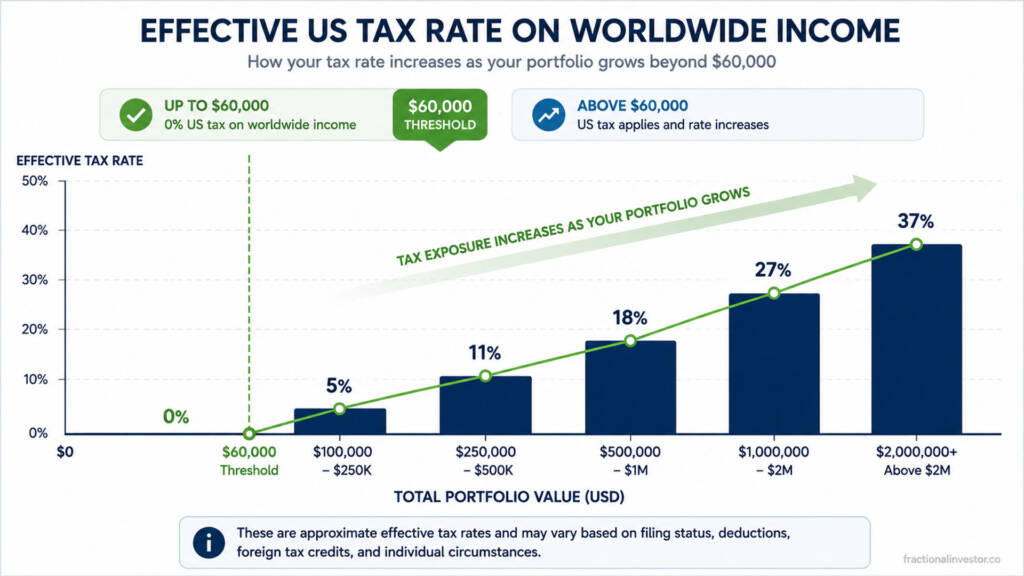
Most articles stop at “up to 40%.” That number is misleading, because 40% is a marginal rate that only applies above $1 million. The effective rate is what actually matters.
The table below is our own calculation. We applied the unified rate schedule from Table A of the IRS Instructions for Form 706 (Rev. 9-2025) to a range of portfolio values, subtracted the $13,000 NRA unified credit, and converted each value into VOO shares at the July 22, 2026 price of $687.87. It assumes no treaty relief and no deductions.
| US-situs portfolio | ≈ VOO shares | Estate tax due | Effective rate on total | Rate on amount above $60k |
|---|---|---|---|---|
| $60,000 | 87 | $0 | 0.0% | — |
| $100,000 | 145 | $10,800 | 10.8% | 27.0% |
| $250,000 | 363 | $57,800 | 23.1% | 30.4% |
| $500,000 | 727 | $142,800 | 28.6% | 32.5% |
| $1,000,000 | 1,454 | $332,800 | 33.3% | 35.4% |
| $2,000,000 | 2,908 | $732,800 | 36.6% | 37.8% |
Illustrative calculation based on current IRS rate tables and the July 22, 2026 VOO price. Assumes no estate tax treaty applies and no deductions are claimed. Actual outcomes depend on individual circumstances. Past performance does not guarantee future results.
The line that should get your attention is the third one. A $250,000 position — perfectly achievable for a disciplined investor over ten to fifteen years of consistent contributions — carries roughly $57,800 of exposure. That is more than four years of median household savings for many investors, erased by a structural choice made on day one.
Notice also how quickly the effective rate climbs. By $250,000, more than 30% of every dollar above the threshold is exposed. The problem does not stay small.
Do You Have a Treaty? Reconciling the Conflicting Counts
Estate tax treaties can raise the exemption dramatically. The US-UK treaty, for example, lets UK residents claim the full US exemption amount instead of the $60,000 floor.
But when we cross-checked how many such treaties exist, sources disagreed sharply — we found published counts of 12, 14, 15, and 16 across reputable tax and legal publishers within the past 18 months. That variation is worth explaining, because it tells you something about how to read tax content generally.
The discrepancy comes from three counting choices:
- Whether Canada is included. Canada’s estate tax provisions sit inside Article XXIX B of the US-Canada income tax treaty rather than a standalone estate treaty, so some lists omit it.
- Whether estate-only and gift-only treaties are counted separately. Some countries have both; others have only one.
- Whether inheritance-tax arrangements outside the IRS list are folded in.
The authoritative answer is the IRS’s own table, which lists 15 jurisdictions: Australia, Austria, Canada, Denmark, Finland, France, Germany, Greece, Ireland, Italy, Japan, Netherlands, South Africa, Switzerland, and the United Kingdom.
If your country is not on that list — and most of Asia, Latin America, the Middle East, and Africa are not — you get the $60,000 floor with no relief. Treaty benefits are also never automatic; claiming them requires attaching a statement identifying the specific treaty and article to Form 706-NA.
The Irish-Domiciled Alternative — and What It Actually Costs
The standard solution is to hold the same index through an Irish-domiciled UCITS ETF. Ireland-domiciled funds are not US-situs assets, so they sit outside US estate tax entirely, and non-residents of Ireland are not liable for Irish inheritance tax either.
The two dominant S&P 500 options are CSPX (iShares Core S&P 500 UCITS ETF) and VUAA (Vanguard S&P 500 UCITS ETF), both accumulating, both physically replicated, and both charging a 0.07% TER as of mid-2026. CSPX is the larger and longer-established of the two, with roughly $95 billion in assets; VUAA’s fund size was listed at approximately €29.6 billion by justETF as of July 2026.
Here is where it gets interesting, and where most coverage stops short.
Irish-domiciled funds pay 15% US withholding tax on dividends at the fund level under the US-Ireland treaty. A direct holder of VOO pays either 15% (with an income tax treaty) or 30% (without one). So the real comparison is total annual drag, not headline TER.
Using VOO’s mid-range yield of about 1.10% as of July 2026:
| Investor type | Withholding drag | Fund fee | Total annual cost |
|---|---|---|---|
| VOO — no income tax treaty | 0.330% | 0.03% | 0.360% |
| VOO — 15% treaty rate | 0.165% | 0.03% | 0.195% |
| Irish UCITS (CSPX/VUAA) | 0.165% | 0.07% | 0.235% |
Our calculation using a 1.10% yield midpoint. Illustrative; actual withholding depends on your country’s treaty status.
Two conclusions fall out of this, and they point in opposite directions:
If you have no US income tax treaty, the Irish fund is roughly 0.125% per year cheaper than VOO. The estate tax protection is not a cost — it is a bonus attached to a better deal. There is essentially no financial argument for holding VOO directly.
If you do have a 15% treaty rate, the Irish wrapper costs about 0.04% more per year. On a $250,000 portfolio that is $100 annually — against a $57,800 estate tax exposure. You are paying roughly 1/578th of the exposure each year to eliminate it. Framed as insurance, few premiums are that cheap.
We walk through a similar withholding-drag analysis for global funds in our VWRA vs VXUS comparison, and compare the Irish and US S&P 500 wrappers head-to-head in VWRA vs VOO.
Risks & Limitations of the Irish Workaround
Switching domicile solves one problem. It is not free of trade-offs, and honest coverage has to say so.
- Punitive treatment for US persons. UCITS ETFs are generally classified as Passive Foreign Investment Companies by the IRS. If you are a US citizen or green card holder living abroad, the Irish route is the wrong answer and can create severe tax consequences.
- Home-country tax on accumulating funds. Accumulating share classes reinvest dividends internally, which defers tax in many jurisdictions — but a few countries tax notional accumulated income annually. Check your local rules before assuming a deferral benefit.
- Liquidity and spreads. UCITS funds trade on European exchanges with lower volume than US-listed ETFs, and you may face wider spreads or currency conversion costs. Choose the listing your broker trades most cheaply.
- Treaty and legislative risk. Both the $60,000 threshold and the US-Ireland treaty rate are creatures of law and can change. A structure that works in 2026 is not guaranteed to work permanently.
- This is not legal certainty. Situs rules involve genuine grey areas, particularly around cash, derivatives, and jointly held accounts. Baker Tilly explicitly flags uncertainty in the classification of cash held in bank versus brokerage accounts.
- The switch may trigger tax where you live. Selling VOO to buy CSPX is a disposal in most jurisdictions, even though nonresident aliens face no US capital gains tax.
Who Should Hold VOO Directly — and Who Shouldn’t
After working through the mechanics, the decision usually comes down to four questions.
VOO directly is likely fine if you:
- Are a US citizen, green card holder, or US-domiciled resident
- Live in one of the 15 estate tax treaty jurisdictions and have confirmed your treaty’s terms
- Expect your total US-situs holdings to stay comfortably under $60,000
- Have deliberately structured ownership through a properly advised entity or trust
An Irish-domiciled UCITS fund deserves serious consideration if you:
- Are a nonresident alien from a non-treaty country
- Expect US-situs assets to exceed $60,000 within your investing lifetime — which, at $100 a month with market returns, arrives faster than most people assume
- Would find a 12-to-18-month asset freeze materially damaging to your family
- Pay 30% dividend withholding today, in which case the switch improves your returns regardless
If you are still building your first core position and want to compare execution costs across brokers, Interactive Brokers offers direct access to both US and European listings from a single account: open an IBKR account here. Disclosure: this is an affiliate link; we may earn a commission at no cost to you.
Conclusion & Call to Action
My own view, after years of thinking about ETF structure, is that this is one of the rare situations in investing where a single decision made early has enormous consequences and almost no cost. Most portfolio “optimizations” trade one risk for another. This one does not — for non-treaty investors it lowers annual costs and removes a six-figure liability.
VOO remains a superb fund and belongs at the core of a long-term portfolio. The question was never whether VOO is a good investment. It is whether you, given your passport and tax domicile, should own it in that particular wrapper. For a large share of international readers, the honest answer is no — and the alternative holds precisely the same 500 companies.
Check your total US-situs exposure this week. If it is approaching $60,000, that is your signal to act.
Have you switched to Irish-domiciled ETFs, or are you still weighing it? Share your reasoning in the comments — and if you want the broader structural case for building around a low-cost index core, read our VOO core portfolio guide next.
Frequently Asked Questions
Q1: Does US estate tax apply if I hold VOO through a broker in my own country? Yes, in almost all cases. US estate tax follows the situs of the asset, not the location of your brokerage account. Interactive Brokers has confirmed that US stocks and US-domiciled ETFs held at its non-US entities remain US-situs assets. The only reliable way to change the answer is to change what you own, not where you hold it.
Q2: How much can I hold in VOO before US estate tax becomes a concern? The filing threshold is $60,000 of total US-situs assets measured at the date of death — not per account and not per holding. Because it includes US stocks, US ETFs, brokerage cash, and other US-situs property combined, the threshold arrives sooner than most investors expect. At current prices, roughly 87 shares of VOO reaches it on its own.
Q3: Will my family really be unable to access the account, or is that exaggerated? It is real. US financial institutions generally require an IRS Transfer Certificate (Form 5173) before releasing a deceased nonresident’s assets, and the IRS issues it only after estate tax has been fully discharged or provided for. Complete filings commonly take 12 to 18 months to process. Some estates need a transfer certificate even when the assets fall below $60,000 and no tax is owed, simply to satisfy the institution.
Sources
- IRS — Estate & gift tax treaties (international)
- IRS — Instructions for Form 706 (Rev. September 2025), Table A Unified Rate Schedule
- IRS — Transfer certificate filing requirements for estates of nonresidents not citizens of the United States
- IRS — Some nonresidents with U.S. assets must file estate tax returns
- Vanguard Advisors — Vanguard S&P 500 ETF (VOO) product page
- Investing.com — VOO price and yield data
- State Street Global Advisors — Considerations for non-US investors: US-domiciled ETFs vs. Irish-domiciled UCITS ETFs
- Baker Tilly — U.S. gift and estate taxes for non-U.S. persons with U.S. assets
- ACTEC Foundation — US Estate Tax Tips for Non-US Persons and Their Advisors
- Bogleheads — Nonresident alien investors and Ireland domiciled ETFs
- justETF — Vanguard S&P 500 UCITS ETF (USD) Accumulating fund profile
Financial Disclaimer
This article is for educational purposes only and does not constitute financial, tax, or legal advice. The author is not a licensed tax advisor, attorney, or financial adviser. US estate tax and situs rules are complex, fact-specific, and subject to legislative change; treaty benefits are never automatic and depend on your individual domicile and circumstances. Nothing here should be relied upon as a substitute for professional guidance. Please consult a qualified cross-border tax advisor and a licensed financial adviser in your jurisdiction before making any investment or estate planning decision. All investing involves risk, including the possible loss of principal. Past performance does not guarantee future results.