You finally decided to start investing — congratulations. But now you’re staring at a screen full of ETFs and asking: should I buy a small cap ETF, a large cap ETF, or both? It’s a question that trips up thousands of new investors every year. Getting this decision wrong early on can cost you years of compounding growth, or expose you to volatility you’re not emotionally or financially prepared to handle. The good news? Once you understand the core difference between a small cap vs large cap ETF, making a confident, data-backed decision becomes surprisingly straightforward.
Key Takeaways:
- Large cap ETFs like VOO offer stability, lower fees (0.03% expense ratio), and consistent long-term growth — making them the ideal core holding for beginners.
- Small cap ETFs like IWM and IJR offer higher growth potential but carry significantly more volatility and deeper drawdowns.
- Most beginner investors are best served by starting with a large cap foundation, then adding small cap exposure as their confidence and portfolio grow.

What Is a Large Cap ETF?
A large cap ETF is a fund that holds shares of large, well-established companies — typically those with a market capitalization above $10 billion. These funds track major indexes like the S&P 500, which includes 500 of the biggest publicly traded U.S. companies. Think Apple, Microsoft, Amazon, and NVIDIA.
The most popular large cap ETF in the world is Vanguard’s VOO. In a historic milestone, VOO crossed $1 trillion in assets under management on June 2, 2026 — making it the first ETF ever to achieve that threshold. That’s a staggering vote of confidence from millions of investors worldwide. VOO charges just a 0.03% expense ratio and has attracted over $66 billion in net inflows in 2026 alone.
Why Large Cap ETFs Appeal to Beginners
- Lower volatility: Large companies tend to weather economic storms better than smaller firms.
- Proven track record: The S&P 500 has delivered an average annual return of roughly 10% historically.
- Low cost: VOO’s 0.03% fee means you keep nearly every dollar of your return.
- Liquidity: Large cap ETFs are easy to buy and sell at any time during market hours.
- Dividend income: VOO pays a dividend yield slightly above 1%, adding passive income on top of price appreciation.
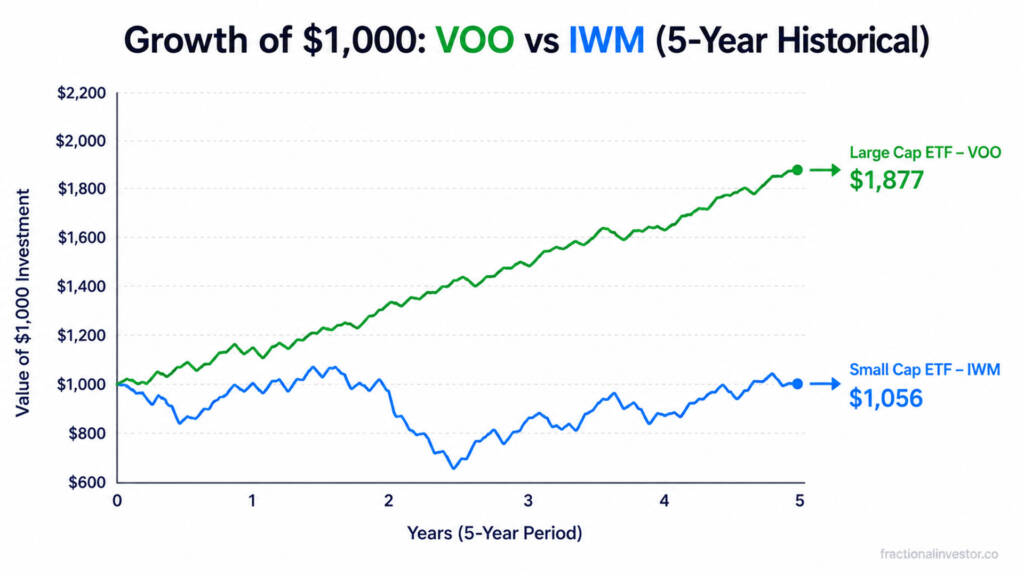
As of June 2026, VOO posted a year-to-date gain of approximately 8.46% and a one-year return of around 24.15%. Over a five-year period, a $1,000 investment in VOO grew to approximately $1,877. That’s the power of consistent, compounding growth in a diversified large cap ETF.
If you’re just starting out, you can also learn the full fundamentals of this asset class in our What Is ETF Investing guide.
What Is a Small Cap ETF?
A small cap ETF holds shares of smaller companies — typically those with market caps between $300 million and $2 billion. These businesses are often growing fast, but they haven’t yet reached the scale and stability of large cap firms. Think of them as the up-and-comers of the stock market.
The two most popular small cap ETFs are the iShares Russell 2000 ETF (IWM) — which tracks the Russell 2000 Index — and the iShares Core S&P Small-Cap ETF (IJR), which follows the S&P SmallCap 600 Index. These are very different funds despite both being “small cap”.
Key Characteristics of Small Cap ETFs
- Higher growth potential: Smaller companies can grow much faster than established giants.
- Greater volatility: Small caps can swing dramatically in either direction.
- Higher fees: IWM charges a 0.19% expense ratio — six times higher than VOO.
- Deeper drawdowns: IWM and similar funds have recorded max 5-year drawdowns near -42% versus SPY’s -24.5%.
- Domestic revenue focus: Most small cap companies earn primarily in the U.S., meaning they’re less exposed to global trade disruptions.
In early 2026, small caps actually surged as mega-cap tech stocks stalled. IWM rallied 7.3% year-to-date by January 2026, while the S&P 500 traded flat due to lagging tech. And over a one-year period as of March 2026, IWM delivered returns near 22.9%. However, over the longer five-year horizon, the Russell 2000 grew only a cumulative 23% compared to 82.5% for the S&P 500. This gap highlights a critical truth: short-term outperformance doesn’t always translate to long-term dominance.
Small Cap vs Large Cap ETF: Head-to-Head Data (2026)
Here’s a direct comparison of the most popular ETFs in each category, based on data available as of June 2026:
The numbers tell a compelling story. While small caps can deliver exciting short-term pops, VOO has dramatically outpaced IWM over a five-year period. Meanwhile, IJR — which uses a stricter quality screen — tends to be a more refined small cap option than IWM.
Risk and Volatility: The Critical Difference
This is where the small cap vs large cap ETF debate really separates experienced investors from beginners. It’s not just about returns — it’s about your ability to stay invested when markets fall.
Volatility and Emotional Investing
When your portfolio drops 20%, it hurts. But when it drops 40%, many investors panic and sell — locking in losses at the worst possible time. IWM’s five-year max drawdown of -42% means an investor who put in $10,000 saw their portfolio shrink to roughly $5,800 at the worst point. Can you emotionally handle that without selling?
VOO’s max drawdown of -24.5% is still painful, but significantly more manageable for most people. That stability is why beginner investors are consistently advised to build their foundation with large cap ETFs first. You can read more about navigating market downturns in our article on What to Do When the Stock Market Crashes.
The Beta Factor
Small cap ETFs have a 5-year beta of approximately 1.30, meaning they are 30% more volatile than the broad market benchmark. Large cap ETFs like VOO track almost 1:1 with the market. For a beginner investor, this extra volatility is almost never worth the tradeoff until you have a solid foundation in place.
The Valuation Opportunity in Small Caps (2026 Context)
Here’s something genuinely interesting about the current market environment. Historically, small caps have traded at a valuation premium of up to 30% versus large caps. But as of 2026, they’re trading at a 30% discount — a gap not seen in over 20 years. This suggests that small caps could be significantly undervalued relative to their historical norms.
Does this mean you should rush into small cap ETFs? Not necessarily — especially if you’re just starting out. But it does mean that adding a satellite allocation to small cap ETFs as a complement to your large cap core could make strategic sense. We explore this approach in detail in our Core and Satellite Portfolio Strategy guide.
Compounding Simulation: What $200/Month Looks Like Over 20 Years
Let’s ground this in real numbers. Using historical average annual returns — approximately 10% for large caps and 8% for small caps over the long run — here’s what a $200/month investment looks like:
$200/Month in VOO (Large Cap, ~10% avg. annual return):
- After 10 years: ~$38,400
- After 20 years: ~$152,000
- After 30 years: ~$452,000
$200/Month in IWM (Small Cap, ~8% avg. annual return):
- After 10 years: ~$35,000
- After 20 years: ~$118,000
- After 30 years: ~$298,000
These are projected outcomes based on historical returns and are not guaranteed. Actual results will vary. But the compounding gap widens dramatically over time. That’s why starting with a stable large cap ETF core is so powerful — and why consistency matters far more than chasing short-term winners.
For a deeper dive on this concept, check out our guide on Dollar-Cost Averaging Explained and our article on Investing $50 a Month in VOO.
Which Should Beginners Actually Buy?
Here is a straightforward, honest answer:
Start with a large cap ETF like VOO as your core holding. It offers the best combination of stability, low cost, long-term performance, and simplicity for new investors. It literally just crossed $1 trillion in assets — that’s not a coincidence. Millions of experienced investors trust it as their primary wealth-building vehicle.
Once your portfolio reaches a level you’re comfortable with — say, $5,000 to $10,000 — you can consider adding a small cap ETF like IJR as a satellite position (perhaps 10–20% of your portfolio). IJR’s quality screen makes it a smarter small cap entry point than IWM for most investors.
A Simple Beginner Allocation
- 80% VOO — Large cap core for stability and consistent long-term growth
- 20% IJR or IWM — Small cap satellite for additional growth potential
This mirrors the principles covered in our 3-ETF Portfolio Strategy guide, which walks you through building a complete, diversified portfolio with just a handful of funds. You can also use our FIRE Calculator to model how this allocation aligns with your financial independence goals.
How to Buy Small Cap and Large Cap ETFs
Ready to take action? Here’s a simple step-by-step process:
- Open a brokerage account. Interactive Brokers (IBKR) is an excellent choice for both U.S. and international investors — offering low commissions, fractional shares, and access to all major ETFs.
- Fund your account. Even $50–$100/month is enough to get started meaningfully.
- Buy VOO first. Place a market or limit order for VOO to establish your large cap core.
- Set up automatic contributions. Automate your monthly investment to remove emotion from the process.
- Add small cap exposure later. Once comfortable, allocate a portion to IJR or IWM to capture the small cap premium.
- Rebalance periodically. Review your allocation once or twice a year. See our How Often to Rebalance Your Portfolio guide for best practices.
For a broader comparison of your ETF options, Investopedia’s ETF Education Center is an authoritative resource that covers fund structures, tax treatment, and selection criteria in depth.
Common Mistakes Beginners Make With ETF Selection
Even with the right information, new investors often fall into predictable traps. Watch out for these:
- Chasing recent performance: Small caps surged in early 2026. Buying after a run-up often means buying near the top.
- Ignoring expense ratios: A 0.19% fee on IWM vs 0.03% on VOO may sound small, but it compounds into a meaningful drag over decades.
- Over-diversifying too early: Owning 10 different ETFs when you have $1,000 is counterproductive. Keep it simple at first.
- Panic selling during drawdowns: Small cap funds can drop 40%+ in a bear market. Without mental preparation, beginners often sell at the worst time.
- Skipping the fundamentals: Make sure you understand common beginner investor mistakes before committing capital.
Conclusion & Call to Action
The small cap vs large cap ETF debate doesn’t have a single “right” answer — but for most beginners, the path forward is clear. Start with VOO as your large cap core. It’s low-cost, battle-tested, and backed by over a trillion dollars in investor confidence. As your knowledge and portfolio grow, add a measured small cap allocation through IJR or IWM to capture additional upside without destabilizing your foundation.
The best ETF is ultimately the one you can hold through market storms without flinching. Building that emotional resilience starts with choosing the right starting point.
Have a question about building your first ETF portfolio? Drop it in the comments below — the Fractional Investor community is here to help. And if you found this guide useful, check out our deep-dive on the VOO ETF Core Portfolio Strategy for your next read.
FAQs
Q1: Is a small cap ETF better than a large cap ETF for long-term growth?
A1: Not necessarily. While small cap ETFs historically carry higher growth potential, the data shows that large cap ETFs like VOO have significantly outperformed small cap ETFs like IWM over the past five years — with a $1,000 investment in VOO growing to ~$1,877 vs ~$1,056 in IWM. Small caps may offer a valuation opportunity in 2026 due to their unusual 30% discount, but for long-term, stable compounding, large cap ETFs remain the stronger foundation.
Q2: What is the best small cap ETF for beginners in 2026?
A2: For beginners exploring small cap exposure, IJR (iShares Core S&P Small-Cap ETF) is generally considered a stronger option than IWM. It uses the S&P SmallCap 600 index, which includes a profitability screen that filters out the weakest small companies — resulting in a higher-quality portfolio. Its expense ratio of 0.07% is also far more competitive than IWM’s 0.19%.
Q3: How much of my portfolio should be in small cap ETFs as a beginner?
A3: Most financial experts suggest keeping small cap exposure to 10–20% of your total portfolio when starting out. The rest should anchor in a diversified large cap ETF like VOO. This “core and satellite” structure gives you broad market stability with a measured tilt toward small cap growth potential. As your knowledge deepens, you can adjust the allocation based on your personal risk tolerance and time horizon.
Financial Disclaimer: This article is published for educational purposes only and does not constitute financial advice, investment recommendations, or a solicitation to buy or sell any securities. All data referenced reflects historical or recent market performance, which is not a guarantee of future results. Every investor’s financial situation is unique. Always conduct your own research and consult with a licensed financial advisor before making any investment decisions. Investing involves risk, including the potential loss of principal.