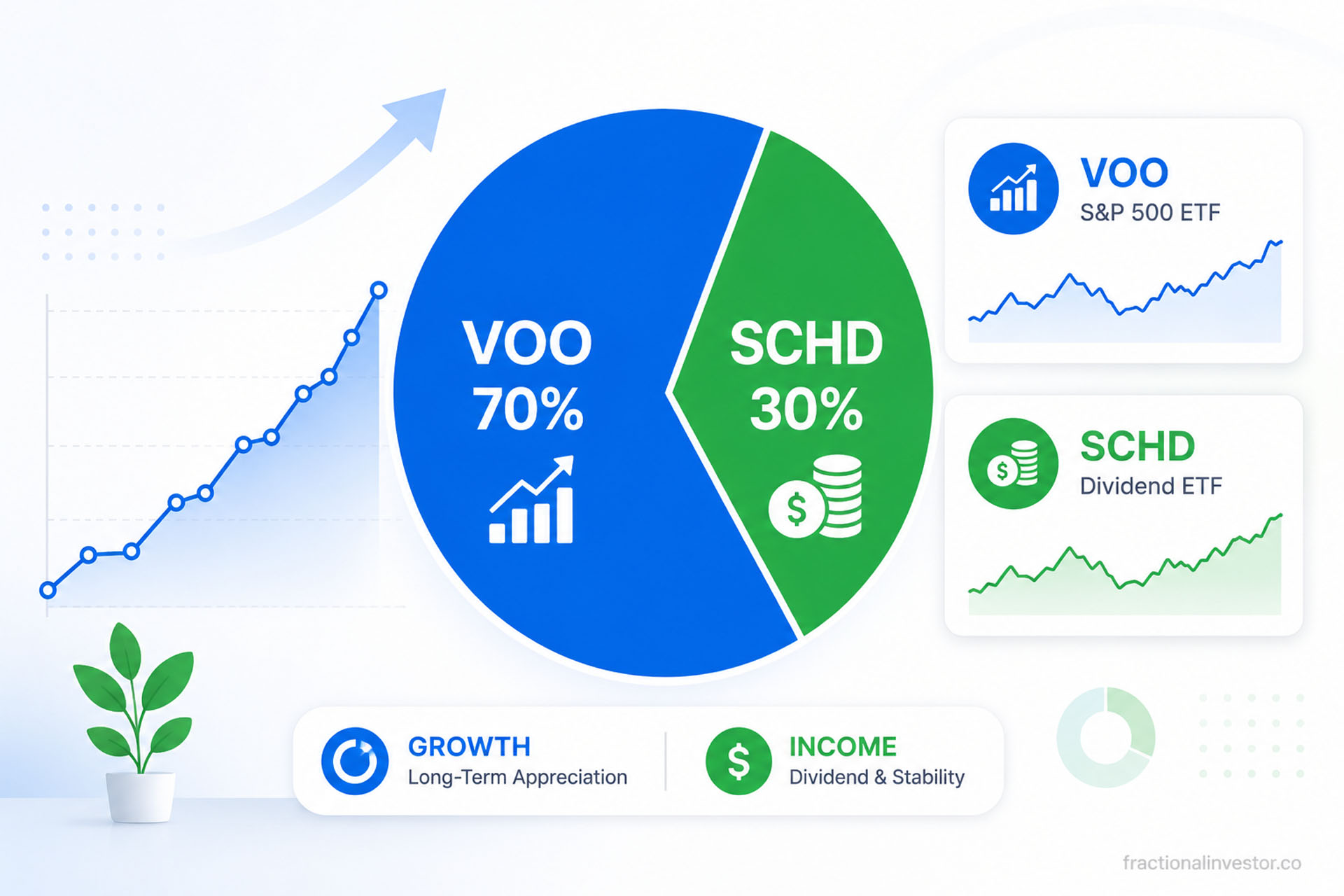
Choosing between growth and income can feel like an impossible trade-off. Load up on growth ETFs, and your dividend income stays frustratingly thin. Chase yield instead, and you risk leaving long-term capital appreciation on the table. The 70 30 portfolio VOO SCHD strategy solves this dilemma by blending the broad-market growth of the Vanguard S&P 500 ETF (VOO) with the dependable, quality-focused dividend income of the Schwab U.S. Dividend Equity ETF (SCHD). With the Federal Reserve holding its benchmark rate near 3.50%–3.75% through mid-2026 and inflation still running above the 2% target, more investors are searching for a single, simple framework that grows wealth while also producing real, spendable cash flow. That is exactly what this combination is designed to do.
Key Takeaways:
- The 70/30 split allocates 70% to VOO for broad S&P 500 growth and 30% to SCHD for dividend income and added stability.
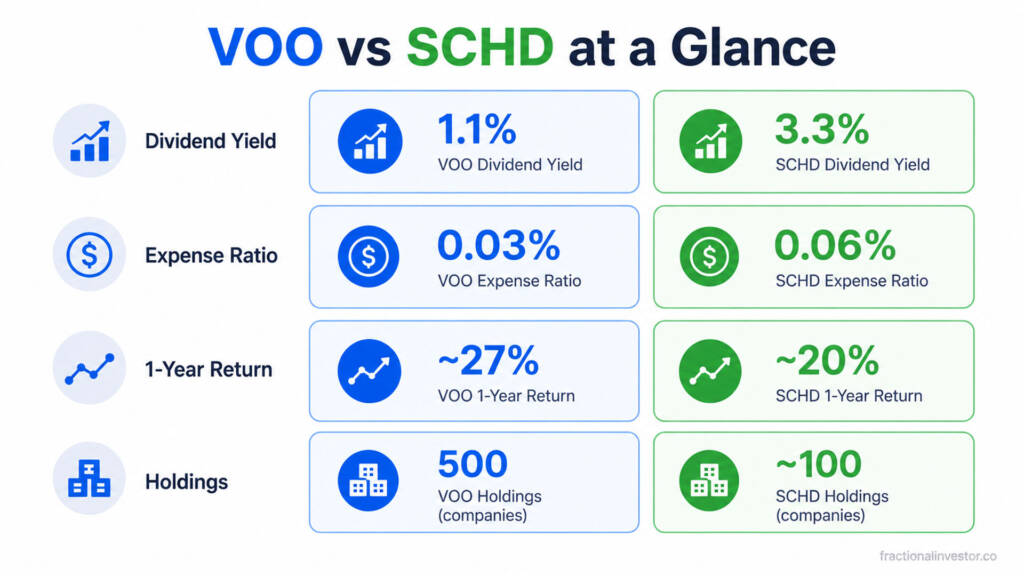
- As of mid-June 2026, VOO trades around $690–$694 with a forward yield near 1.1%, while SCHD trades near $32 with a trailing yield above 3.3%.
- Blending the two historically smooths out income gaps without abandoning the long-term growth engine that makes index investing so powerful.
What Is a 70/30 Portfolio?
A 70/30 portfolio simply means 70% of your invested dollars sit in one asset and 30% sit in another. In this case, it is a two-fund, core-and-satellite style structure built entirely from ETFs rather than individual stocks. It is far simpler than juggling dozens of holdings, yet it still captures two very different return drivers.
Many beginners get stuck overthinking the growth versus dividend investing debate, as if you must pick a side. A 70/30 split sidesteps that entirely. You keep the lion’s share of your money compounding in the broad market while carving out a meaningful slice for income that lands in your account every quarter, rain or shine.
Why Pair VOO and SCHD Specifically?
VOO and SCHD complement each other because they behave differently under different market conditions:
- VOO is market-cap weighted, so it leans heavily into the largest U.S. companies, including major technology names.
- SCHD screens for quality, profitability, and dividend sustainability, which tilts it toward financials, healthcare, and consumer staples.
- Lower overlap between the two means SCHD can hold up better during growth-stock pullbacks, while VOO captures upside during bull runs.
If you are still building conviction on indexing in general, our what is ETF investing guide is a useful starting point before going further.
VOO Explained: The Growth Backbone of Your Portfolio
VOO is Vanguard’s S&P 500 ETF, and it forms the foundation of countless long-term portfolios for good reason. It tracks 500 of the largest publicly traded U.S. companies at a rock-bottom 0.03% expense ratio, meaning fees barely dent your returns over decades.
As of this writing, VOO trades in the $690–$694 range, sitting near the upper half of its 52-week range of roughly $543 to $699. Trailing one-year returns have been exceptionally strong, with VOO up close to 26–27% over the past twelve months, reflecting a powerful market rally heading into mid-2026. The fund’s forward dividend yield sits around 1.1%, which is typical for a growth-oriented, broad-market index fund.
This is precisely why broad-market ETFs like VOO should anchor the core of any long-term portfolio. It is diversified across nearly every major sector, requires zero stock-picking, and has historically rewarded patient investors who stay invested through volatility. For a deeper comparison of similar core options, see our breakdowns of VOO vs. SPY, VTI vs. VOO, and QQQ vs. VOO.
SCHD Explained: The Income and Quality Engine
SCHD takes a very different approach. Instead of tracking the whole market, it screens for U.S. companies with a sustained history of paying dividends, strong free cash flow, and solid return on equity. The result is a more concentrated, quality-tilted portfolio of roughly 100 holdings.
SCHD currently trades near $32 per share, with a trailing dividend yield of approximately 3.3% and a five-year dividend growth rate north of 11% annually. The fund has had a strong 2026 so far, climbing close to 20% year-to-date as capital rotated from high-growth names into value and dividend stocks amid expectations around the Fed’s rate path. Its expense ratio of 0.06% remains very competitive for an actively screened, rules-based strategy.
What makes SCHD valuable in a 70/30 structure is not just the yield itself, but the quality of that yield. The underlying screening methodology tends to avoid overleveraged companies, which historically has helped the fund hold up reasonably well during periods of rate uncertainty. For more detail, check out our full SCHD ETF review and our SCHD vs. VYM comparison.
The 70 30 Portfolio VOO SCHD Allocation: How the Math Works
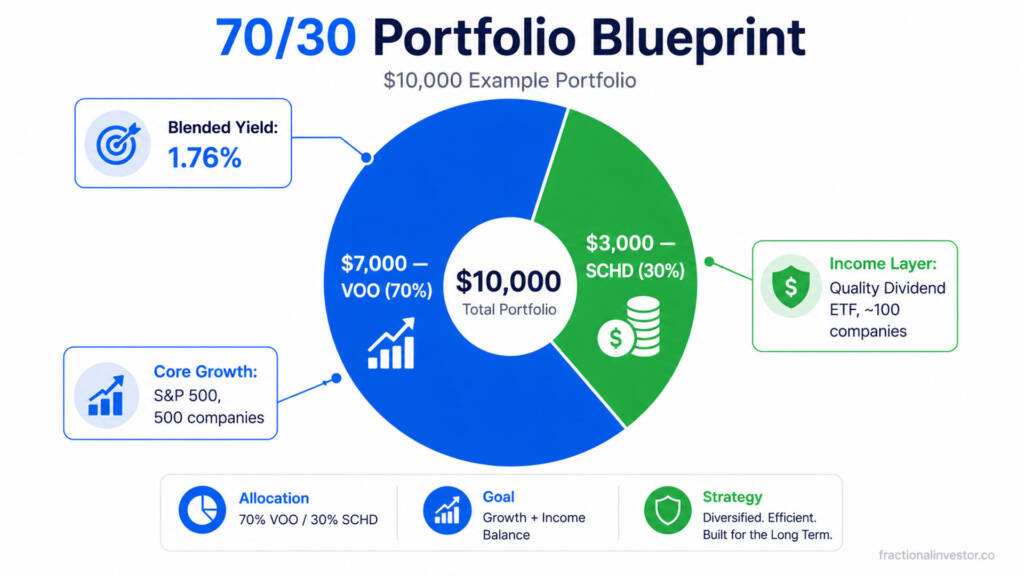
Here is where the 70 30 portfolio VOO SCHD approach gets practical. Suppose you have $10,000 to invest:
- $7,000 → VOO (70%)
- $3,000 → SCHD (30%)
Now look at the blended income effect. Using current yields of roughly 1.1% for VOO and 3.3% for SCHD:
- 100% VOO portfolio: approximately 1.1% blended yield
- 70/30 VOO/SCHD portfolio: approximately 1.76% blended yield
That is roughly 60% more annual income generated from the same total investment, simply by shifting 30% of the portfolio into a quality dividend ETF. You are not sacrificing the market’s long-term growth engine; you are layering meaningful income on top of it. If you are automating contributions, our guide on dollar-cost averaging explains how to keep adding to both positions consistently regardless of price swings.
Hypothetical Growth Example: Investing $500 a Month
Let’s walk through a simplified, hypothetical compounding simulation. This is not a guaranteed outcome — it is an illustration based on blended historical long-term return assumptions for a 70/30 VOO/SCHD style allocation, which has historically landed in the high single digits to low double digits annually, including reinvested dividends.
Assume a blended 9.7% average annual return (a simplified, illustrative midpoint, not a promise) and $500 invested every month:
- After 10 years: contributions alone would total $60,000. With compounding at the assumed rate, the projected balance would be roughly $93,000–$95,000.
- After 20 years: contributions alone would total $120,000. The projected balance would be roughly $325,000–$335,000.
These figures exclude any starting lump sum and assume dividends from SCHD are reinvested rather than spent. Real-world results will vary significantly depending on market conditions, sequence of returns, and how disciplined you are about staying invested during downturns. For a related strategy using a smaller starting amount, see investing $50 a month in VOO or our broader guide to investing $100 a month in ETFs.
Pros and Cons of the 70/30 Portfolio
Pros:
- Generates noticeably more income than a 100% VOO portfolio
- Keeps the majority of assets in proven, low-cost broad-market growth
- Reduces single-sector concentration risk by blending tech-heavy growth with value-tilted dividend payers
- Simple to manage with only two funds
Cons:
- Still 100% equities, with no bond allocation to cushion downturns — see our bond ETFs for beginners guide if you want to add a fixed-income sleeve
- Requires periodic rebalancing as VOO and SCHD grow at different rates
- Dividend income from SCHD is taxable in a standard brokerage account each year, which is worth considering — our best ETFs for a Roth IRA guide covers tax-advantaged placement
- New investors sometimes make avoidable errors when starting out; review common beginner investor mistakes before you begin
How to Rebalance Your 70/30 VOO/SCHD Portfolio
Because VOO often grows faster during bull markets, your allocation can drift toward 75/25 or even 80/20 over time without any action on your part. Most long-term investors check their allocation once or twice a year and rebalance only if it has drifted by more than 5 percentage points from target. For a full walkthrough of timing and methods, see how often to rebalance your portfolio. You can also reduce manual effort by automating your ETF investments and directing new contributions toward whichever fund has fallen below target.
Is the 70/30 VOO/SCHD Portfolio Right for You?
This strategy tends to suit investors who want more current income than a pure growth approach offers, without fully sacrificing long-term compounding. It is a strong fit for intermediate investors building toward financial independence — you can model your own timeline using our FIRE calculator — as well as anyone comparing structures in our 3-ETF portfolio strategy or passive income ETF portfolio guides.
According to Vanguard, broad diversification and low costs remain two of the most reliable, evidence-backed drivers of long-term investor outcomes — both of which this 70/30 structure delivers in a simple, two-fund package.
Conclusion & Call to Action
The 70 30 portfolio VOO SCHD strategy offers a practical middle ground for investors who refuse to choose between growth and income. By keeping 70% in VOO’s broad market exposure and 30% in SCHD’s quality dividend focus, you build a portfolio that can compound aggressively while still paying you along the way. As always, treat any projected figures as historical, illustrative references rather than promises — markets move in both directions.
If this breakdown was helpful, drop a comment below with your current allocation, or check out our related guide on building a dividend portfolio for additional income-focused ideas. Ready to put new contributions to work? You can open a brokerage account through Interactive Brokers to start building your own VOO/SCHD allocation today.
FAQs
Q1: What is the ideal account type for a 70 30 portfolio VOO SCHD strategy? A1: Many investors prefer holding SCHD inside a Roth IRA or other tax-advantaged account to shield its quarterly dividends from annual taxation, while VOO can work well in either taxable or tax-advantaged accounts since it pays a smaller yield.
Q2: How does a 70/30 VOO/SCHD portfolio compare to a 60/40 split? A2: A 60/40 VOO/SCHD split shifts more weight toward income and slightly reduces long-term growth potential, while a 70/30 split leans further into capital appreciation. The right ratio depends on your personal income needs versus growth timeline.
Q3: Can beginners start a 70/30 VOO SCHD portfolio with a small amount of money? A3: Yes — because both ETFs trade as fractional shares on most modern brokerages, you can start with as little as $50–$100 per month and maintain the 70/30 ratio by directing new contributions proportionally between the two funds.
Financial Disclaimer
This article is for educational and informational purposes only and does not constitute financial, investment, or tax advice. All figures, prices, and yields referenced are illustrative snapshots as of mid-June 2026 and will change over time. Past performance does not guarantee future results. Always consult a licensed financial advisor before making any investment decisions.