You want to invest — but $100 a month feels like too little to matter. You scroll through finance content and see people talking about $500 or $1,000 monthly contributions, and it’s easy to feel like you’re already behind before you’ve even started. Here’s the truth: $100 a month, invested consistently into the right ETFs, can grow into a life-changing sum over time. In this guide, you’ll learn exactly how to invest $100 a month in an ETF strategy, which funds to choose, and what the math really looks like.
Key Takeaways:
- Investing just $100 a month into a broad-market ETF like VOO — based on the S&P 500’s historical ~10% annualized return — could grow to over $75,000 in 20 years and $226,000 in 30 years.
- As of June 16, 2026, VOO trades at approximately $693.54 per share and has crossed $1 trillion in assets under management — making it the world’s most trusted ETF.
- Fractional shares mean you can start with any dollar amount today, regardless of an ETF’s share price.
Why $100 a Month Is More Powerful Than You Think
Most people underestimate small, consistent contributions. The reason is compounding — the process by which your investment gains generate their own gains over time. Albert Einstein allegedly called it the “eighth wonder of the world,” and the math backs that up completely.
The S&P 500 has delivered an average annual return of approximately 10% over its full history, and closer to 14.8% over the past decade (January 2016 through December 2025). Even using the more conservative long-run estimate, $100 a month over 30 years produces a result that most people earning average salaries would struggle to replicate through saving alone.
Furthermore, 2026 has already demonstrated why staying invested matters. VOO — the Vanguard S&P 500 ETF — dipped in early 2026 before recovering, and as of June 15, 2026, it trades at $693.54 per share, up significantly from its early-year lows. Investors who kept contributing through that dip bought more shares at lower prices, improving their long-run average cost. That’s the engine behind the invest 100 a month ETF strategy.
The Math Behind the Method
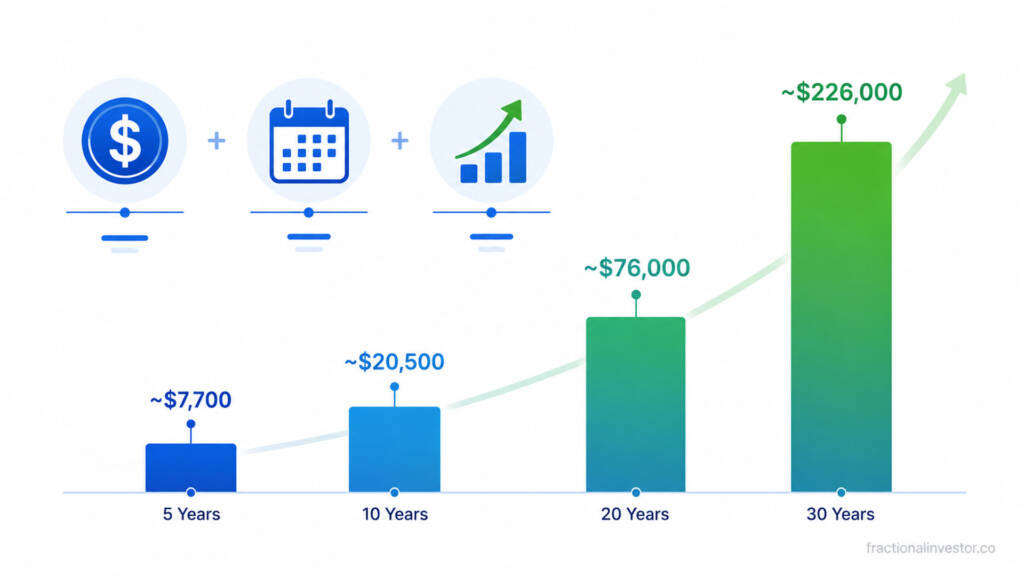
Here is a realistic compounding projection for $100/month invested into a broad-market ETF, using the S&P 500’s conservative historical average of ~10% annualized total return:
| Years Invested | Total Contributed | Projected Portfolio Value* |
|---|---|---|
| 5 years | $6,000 | ~$7,744 |
| 10 years | $12,000 | ~$20,484 |
| 15 years | $18,000 | ~$41,447 |
| 20 years | $24,000 | ~$75,937 |
| 25 years | $30,000 | ~$132,683 |
| 30 years | $36,000 | ~$226,049 |
*Projected using ~10% historical annualized return with monthly compounding. Past performance does not guarantee future results.
Notice that your total contribution after 30 years is just $36,000 — but your projected portfolio value exceeds $226,000. That’s more than $190,000 created purely by compound growth. This is exactly why starting early matters far more than starting with a large amount.
To model your own numbers based on your target retirement date, try our FIRE Calculator.
The Best ETFs to Invest $100 a Month In
Not every ETF is built for consistent monthly investing. For a disciplined, long-term “invest $100 a month” strategy, you need funds that are diversified, low-cost, and liquid enough to support fractional share purchases.
Here are the top three ETFs to consider, along with their current performance context as of June 2026:
VOO — Vanguard S&P 500 ETF (Core Holding)
VOO is the single most recommended ETF for beginner and intermediate investors. It tracks the S&P 500 — the 500 largest publicly traded US companies — and carries an ultra-low expense ratio of just 0.03%. As of June 15, 2026, VOO trades at $693.54 per share and has just become the first ETF in history to surpass $1 trillion in assets under management.
This ETF should form the core of any $100/month investment plan. It is backed by the same index that has averaged approximately 10% annually over the long run. Explore more in our dedicated VOO ETF Core Portfolio guide, and see how it compares in our VOO vs. SPY 2026 analysis.
VTI — Vanguard Total Stock Market ETF (Diversifier)
VTI goes beyond the S&P 500 to include over 3,500 US stocks — covering large-cap, mid-cap, and small-cap companies. It offers slightly broader exposure than VOO and has a similar 0.03% expense ratio. Adding VTI alongside VOO gives your portfolio depth across more of the US economy. For a full breakdown of the differences, read our VTI vs VOO comparison.
SCHD — Schwab US Dividend Equity ETF (Income Layer)
SCHD has been a standout performer in 2026. As of June 12, 2026, SCHD posted a year-to-date return of approximately +20.66%, significantly outperforming the broader S&P 500 index year-to-date. It focuses on high-quality dividend-paying US companies and provides a quarterly cash income stream that can be automatically reinvested. For investors who want both growth and income from their $100 monthly contribution, SCHD is an excellent addition. Read our full SCHD ETF Review 2026 or compare it to a growth alternative in Growth vs Dividend Investing.
How to Allocate Your $100 a Month
The good news is that $100 a month is surprisingly flexible. Most platforms support fractional shares, which means you don’t need to buy a full share of VOO at ~$693. Instead, you invest your dollar amount and receive a proportional fraction of a share.
Here are three simple allocation models based on your investing goal:
Model 1: Pure Growth (Beginner Simplicity)
| ETF | Monthly Amount | Purpose |
|---|---|---|
| VOO | $100 | 100% S&P 500 core growth |
This is the simplest possible approach. Put all $100 into VOO every month. Automate it. Reinvest dividends. This model requires zero decision-making after setup and benefits fully from the S&P 500’s long-run trajectory.
Model 2: Growth + Income (Balanced)
| ETF | Monthly Amount | Purpose |
|---|---|---|
| VOO | $70 | Core S&P 500 growth |
| SCHD | $30 | Dividend income + reinvestment |
This model captures growth through VOO while building a dividend income stream through SCHD. As dividends are reinvested automatically, this “snowball” accelerates over time — a concept explored in depth in our Dividend Snowball Effect guide.
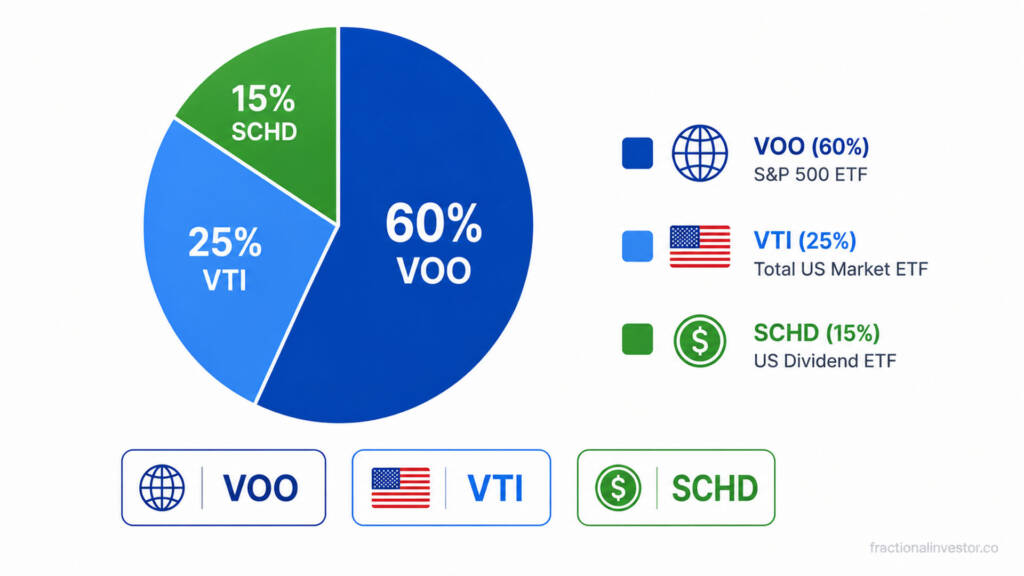
Model 3: Three-ETF Portfolio (Diversified)
| ETF | Monthly Amount | Purpose |
|---|---|---|
| VOO | $60 | US large-cap core growth |
| VTI | $25 | Broad US market diversifier |
| SCHD | $15 | Dividend income layer |
This is the most diversified approach for $100 a month. It mirrors a professional 3 ETF Portfolio Strategy that institutional advisors recommend for passive investors. The small amounts might seem insignificant, but after 20–30 years of consistent contribution and compounding, the result is statistically powerful.
Step-by-Step: How to Start Investing $100 a Month in ETFs
Getting started is simpler than most beginners expect. Follow these five steps to go from zero to automated investor in a single afternoon.
Step 1: Choose Your Brokerage Platform
You need a broker that supports fractional shares and recurring/automatic purchases. Top options include:
- Fidelity — Zero commissions, fractional shares, free automatic investing setup
- Charles Schwab — Fractional shares through Schwab Stock Slices, strong research tools
- Interactive Brokers (IBKR) — Best for international investors accessing US ETFs; supports recurring orders with competitive fees. Open an account with IBKR here
Step 2: Fund Your Account
Link your bank account and set up a monthly transfer of $100 on payday. This removes the temptation to spend it first. Treat your investment contribution like a non-negotiable bill — pay yourself first.
Step 3: Select Your ETFs
Choose your allocation model from the three options above based on your goal:
- Growth only → 100% VOO
- Growth + income → VOO + SCHD
- Full diversification → VOO + VTI + SCHD
If you’re brand new to ETFs, our What Is ETF Investing guide is the perfect starting point before you commit to any allocation.
Step 4: Set Up Automatic Recurring Purchases
Inside your brokerage account, locate the “automatic investing” or “recurring investment” feature. Set your chosen ETF(s) to purchase on the same date each month using your fixed $100. This is the most important step — automation removes emotion from the equation entirely. For a full walkthrough of why this matters, read our Automate Investments ETF Strategy guide.
Step 5: Enable DRIP (Dividend Reinvestment)
Activate your broker’s Dividend Reinvestment Plan (DRIP). This automatically reinvests any dividend payments back into additional ETF shares — at no cost and without any action on your part. Over 10–30 years, reinvested dividends can add tens of thousands of dollars to your portfolio’s final value, as explained in our Dollar-Cost Averaging Explained guide.
Common Mistakes to Avoid When Investing $100 a Month
Even a simple strategy can go wrong without the right discipline. Watch out for these pitfalls:
- Stopping contributions during market downturns — This is the single most common and costly mistake. A down market means your $100 buys more shares. Read our Beginner Investor Mistakes guide for the full list.
- Switching ETFs too frequently — Chasing the top performer each year destroys compounding. Consistency beats strategy rotation every time.
- Ignoring fees — A 1% expense ratio costs you dramatically more over 30 years than a 0.03% ratio. Always check before you buy.
- Not automating — Manual investing relies on willpower, which is finite. Automation is permanent.
For a deeper look at structuring your broader portfolio beyond $100/month, see our Core and Satellite Portfolio framework.
What Happens If You Increase Your Contribution Over Time?
Starting with $100 is great — but what if you increase your contributions as your income grows? Even a modest step-up has a dramatic effect on your final balance.
Here’s a projection showing the difference between a flat $100/month and a strategy where you increase contributions by just $25 every two years:
| Strategy | 30-Year Projected Value* |
|---|---|
| Flat $100/month forever | ~$226,049 |
| Starting at $100, +$25 every 2 years | ~$380,000+ |
*Estimated using ~10% annualized return. Past performance does not guarantee future results.
The gap between the two strategies is over $150,000 — all from small, incremental increases. This is the power of combining growth contributions with compound returns. Use our FIRE Calculator to model your personalized step-up strategy and see what’s possible for your own timeline.
Conclusion & Call to Action
Investing $100 a month in ETFs is not a compromise — it is a proven, powerful strategy that has built generational wealth for disciplined investors across every income level. By choosing VOO as your core, pairing it with income-generating ETFs like SCHD if desired, automating your contributions, and enabling DRIP, you create a system that works silently in the background every single month.
The data is clear. The S&P 500 has delivered approximately 10% annualized returns over its history, VOO just became the world’s first $1 trillion ETF, and even early 2026’s volatility rewarded investors who stayed the course. Your $100 matters — and the best time to put it to work is right now.
👉 Are you already investing $100 a month? Drop a comment below and tell us which ETF you’re using! Or, if you’re looking to take the next step, explore our full Passive Income ETF Portfolio guide to build a cash flow layer on top of your growth strategy.
FAQs
Q1: Is investing $100 a month in ETFs really enough to build wealth long-term?
A1: Yes — absolutely. Based on the S&P 500’s historical ~10% annualized return, investing $100 a month consistently for 30 years projects to a portfolio value exceeding $226,000, despite only contributing $36,000 in total out-of-pocket. The gap between what you put in and what you end up with is created entirely by compounding. The key variables are consistency, time in the market, and keeping costs low with ETFs like VOO (0.03% expense ratio).
Q2: Can I invest $100 a month in VOO if the share price is over $600?
A2: Yes — because most modern brokerages support fractional shares. As of June 16, 2026, VOO trades at approximately $693.54 per share. With fractional investing, your $100 buys you roughly 0.144 of a share each month. Over time, those fractions accumulate into whole shares and full portfolio value. Platforms like Fidelity, Schwab, and IBKR all support fractional ETF purchases.
Q3: What is the best ETF to invest $100 a month in for a beginner in 2026?
A3: For most beginners, VOO (Vanguard S&P 500 ETF) is the single best choice. It tracks the 500 largest US companies, costs just 0.03% annually in fees, and as of 2026 has become the world’s largest ETF with over $1 trillion in assets. If you want to add an income layer alongside growth, pairing VOO (70%) with SCHD (30%) creates a strong, simple two-ETF portfolio. SCHD has posted a year-to-date return of over 20% in 2026 — a powerful combination of income and capital appreciation.
Financial Disclaimer: This article is intended for educational and informational purposes only. It does not constitute financial, investment, or tax advice. The compounding projections and historical data cited are for illustrative purposes only and do not guarantee future results. All investing involves risk, including the possible loss of principal. Past performance is not indicative of future results. Always conduct your own research and consult with a licensed financial advisor before making any investment decisions.