
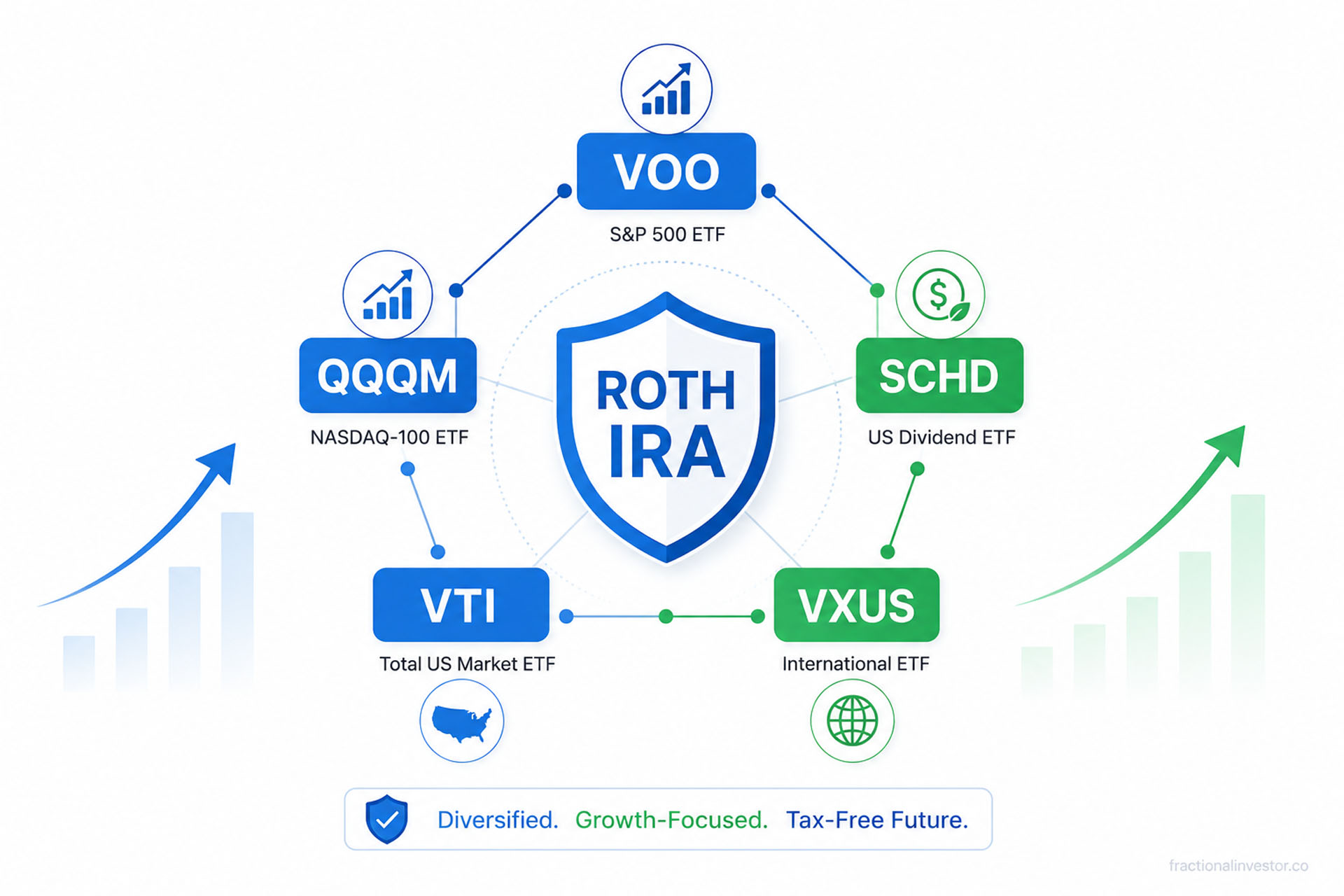
You’re ready to maximize your Roth IRA, but choosing the right ETFs feels overwhelming. With thousands of options and conflicting advice online, picking the wrong funds could cost you decades of tax-free growth. The good news? You don’t need complexity to build wealth. By focusing on five proven, low-cost broad-market ETFs, you can secure your retirement while keeping fees minimal and returns strong.
Key Takeaways:
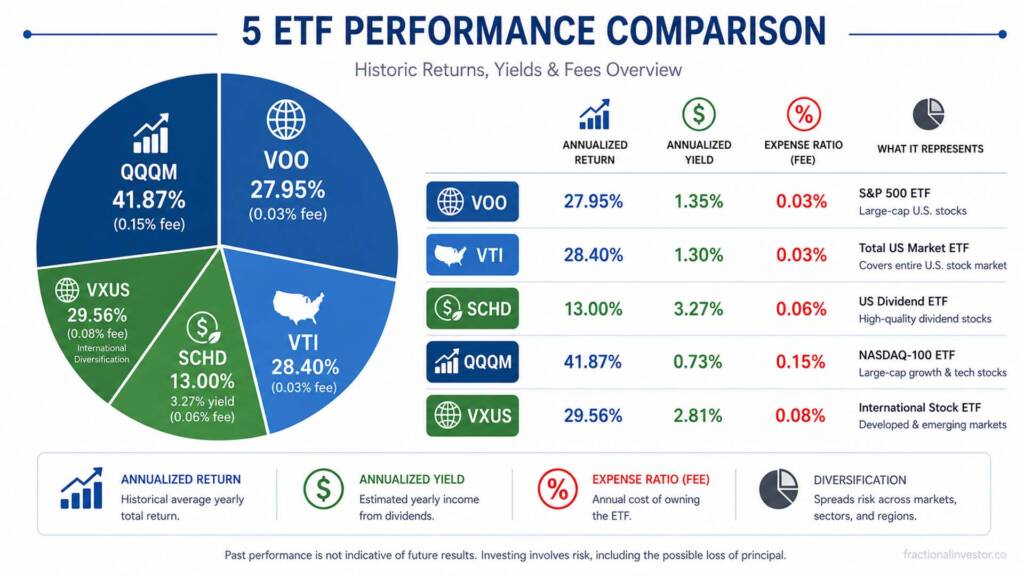
- VOO (Vanguard S&P 500 ETF) serves as the essential core holding with 27.95% past-year total return and just 0.03% expense ratio
- VTI (Vanguard Total Stock Market) offers broader diversification across 3,500+ companies with 28.40% annual return at the same ultra-low 0.03% fee
- SCHD (Schwab U.S. Dividend Equity) provides tax-efficient income with 3.27% yield and 13% annualized returns since inception, perfect for Roth IRA compounding
- QQQM (Invesco NASDAQ 100) delivers technology growth exposure with 41.87% past-year total return for investors seeking innovation sector upside
- VXUS (Vanguard Total International) adds crucial global diversification across 8,000+ non-U.S. companies at 0.08% expense ratio
Why a Roth IRA Is the Ultimate ETF Vehicle
The Roth IRA offers a unique tax advantage that makes it the perfect home for ETF investing. You contribute money now with after-tax dollars, then withdraw completely tax-free in retirement—including all your growth and dividends.
This structure changes everything for ETF selection. In a traditional account, dividend ETFs like SCHD face annual tax drag. But inside a Roth IRA, those 3.27% dividends compound tax-free forever. Growth ETFs like QQQM with minimal dividends also shine here since you never pay taxes on capital gains.
The math is powerful. A $10,000 investment in VOO growing at 10% annually becomes $174,494 in 30 years. In a taxable account, you’d lose thousands to annual taxes. In a Roth IRA, that entire $174,494 is yours.
The Roth IRA Contribution Limit for 2026
For 2026, the contribution limit remains $7,000 for those under 50, and $8,000 for those 50+ (catch-up contribution). If you earn $75,000+, you’re eligible regardless of income. Above $161,000 (single), contributions phase out.
Even investing just $50 monthly in VOO through dollar-cost averaging builds substantial wealth over time. Learn more about dollar-cost averaging explained to automate your strategy.
What Makes an ETF “Best” for Roth IRA?
Not all ETFs are equally suited for Roth IRAs. The best options share five critical characteristics:
1. Ultra-Low Expense Ratios
Fees compound negatively over decades. An ETF with 0.03% (like VOO) costs $3 per $10,000 annually. A 1% fee costs $100—over 30 years, that difference steals $18,000+ from a $174,494 portfolio.
2. Broad Market Diversification
Single-sector ETFs carry concentrated risk. Broad-market ETFs like VTI hold 3,500+ companies across all industries, reducing volatility while capturing overall market growth.
3. Strong Historical Returns
While past performance doesn’t guarantee future results, ETFs with 10+ years of 10%+ annualized returns demonstrate resilience. VOO’s 14.96% average annual return since inception proves this.
4. Tax Efficiency
In taxable accounts, this matters less in Roth IRAs since everything is tax-free. However, ETFs with low portfolio turnover (like index funds) still minimize tracking error.
5. High Liquidity
ETFs with billions in assets and daily trading volume ensure you can buy/sell instantly at fair prices. VOO, VTI, and SCHD all meet this criterion.
The 5 Best ETFs for Roth IRA in 2026: Deep Analysis
Now let’s dive into each ETF with real 2026 data, performance metrics, and realistic compounding scenarios.
1. VOO (Vanguard S&P 500 ETF) — The Essential Core Holding
Current Price (June 16, 2026): $693.83
Expense Ratio: 0.03% ($3 per $10,000)
Dividend Yield: ~1.5%
Past-Year Total Return: 27.95%
YTD Return 2026: +10.99%
Average Annual Return (Inception): 14.96%
VOO tracks the S&P 500, giving you exposure to 500 of America’s largest companies—Apple, Microsoft, Amazon, Nvidia, and more. It’s the single most recommended core holding for Roth IRAs.
Why VOO Dominates Roth IRAs
With 85% overlap to VTI, you could choose either, but VOO’s large-cap focus provides slightly lower volatility while capturing 95%+ of total market returns. At just $693.83 per share, it’s accessible even with monthly $100 investments.
Real Compounding Example:
- Monthly investment: $500
- Duration: 30 years
- Assumed annual return: 10% (historical average)
- Final portfolio: $1,136,424 (tax-free in Roth IRA)
This assumes historical returns, not guaranteed outcomes. Learn how to calculate your own FIRE number at our FIRE calculator.
VOO Portfolio Allocation Recommendation
For most investors, allocate 40-50% of your Roth IRA to VOO as your foundation. This VOO core portfolio strategy has built more wealth than 90% of complex Wall Street strategies.
2. VTI (Vanguard Total Stock Market ETF) — Maximum Diversification
Current Price (June 2026): $327.92
Expense Ratio: 0.03%
Dividend Yield: 1.11%
Past-Year Total Return: 28.40%
YTD Return 2026: 1.05%
Holdings: 3,500+ U.S. companies
VTI expands beyond the S&P 500 to include small-cap and mid-cap stocks, covering the entire U.S. market. If you want “buy America” in one fund, VTI is it.
VTI vs. VOO: Which Should You Choose?
| Metric | VOO | VTI |
|---|---|---|
| Holdings | 500 large-cap | 3,500+ all-cap |
| Past-Year Return | 27.95% | 28.40% |
| Expense Ratio | 0.03% | 0.03% |
| Small-Cap Exposure | 0% | ~20% |
| Volatility | Lower | Slightly higher |
You don’t need both—they’re 85% overlapping. Choose VOO for stability or VTI for maximum diversification. Many investors split 60% VOO / 40% VTI for balance.
Read our detailed VTI vs. VOO comparison to decide.
3. SCHD (Schwab U.S. Dividend Equity ETF) — Tax-Efficient Income
Current Price (June 10, 2026): $32.25
Expense Ratio: 0.06%
Dividend Yield: 3.27% (12-month trailing)
5-Year Annualized Return: 8.59%
10-Year Annualized Return: 12.37%
Inception Annualized Return: 13.01%
SCHD holds 100 high-quality dividend growers with strong cash flows. Unlike growth ETFs, it provides steady income that compounds tax-free in your Roth IRA.
The Dividend Snowball in a Roth IRA
Here’s where SCHD shines: In a taxable account, your 3.27% yield gets taxed annually. In a Roth IRA, those dividends reinvest tax-free, creating a dividend snowball effect.
Real Example:
- $10,000 invested in SCHD at launch (2011)
- Original yield: 2.6%
- Current annual dividend: $124.50
- Yield on cost: 12.5% after 14 years
A $10,000 investment has grown to over $59,000 as of March 2026.
SCHD Allocation Strategy
Allocate 15-25% to SCHD for income stability. This balances growth (VOO/VTI/QQQM) with reliable dividends. Compare SCHD to other dividend ETFs in our SCHD vs. VYM analysis and SCHD vs. DGRO 2026.
4. QQQM (Invesco NASDAQ 100 ETF) — Technology Growth
Current Price (June 16, 2026): $305.76
Expense Ratio: 0.15%
Dividend Yield: 0.45%
Past-Year Total Return: 41.87%
5-Year Return: 103%
Holdings: Top 100 NASDAQ companies (Apple, Microsoft, Nvidia, Amazon)
QQQM is the lower-cost version of QQQ, focusing on the innovation economy. It’s higher risk but delivers massive upside during tech rallies.
Why QQQM Fits Roth IRAs Perfectly
Tech stocks generate minimal dividends, making them tax-inefficient in taxable accounts. But in a Roth IRA, all capital gains are tax-free—QQQM’s 41.87% annual return compounds entirely for you.
Caution: QQQM is volatile. During 2022’s market crash, it dropped 30%. Only allocate what you can tolerate losing short-term.
QQQM Allocation Recommendation
Limit QQQM to 10-15% of your portfolio. This VOO and JEPQ portfolio strategy shows how to balance growth with stability. Compare QQQM to QQQ and other tech ETFs in our QQQ vs. VOO guide.
5. VXUS (Vanguard Total International Stock ETF) — Global Diversification
Expense Ratio: 0.08%
Holdings: 8,000+ non-U.S. companies
5-Year Returns: ~7% (amid emerging market rebounds)
Coverage: Europe, Asia, Emerging Markets, Developed Markets ex-U.S.
VXUS provides crucial international exposure. The U.S. represents only 60% of the global market.Ignoring international stocks means missing 40% of global growth opportunities.
The International Diversification Argument
Morningstar ranks VXUS as a top international pick for 2026, expecting non-U.S. stocks to outperform. Emerging markets are rebounding, and VXUS captures those gains at just 0.08%.
VXUS Allocation Strategy
Allocate 5-10% to VXUS. This isn’t about maximizing returns—it’s about reducing risk through diversification. Learn more in our VWRA vs. VOO international comparison.
Recommended Roth IRA Portfolio Allocation for 2026
Here’s a balanced, data-driven allocation combining all five ETFs:
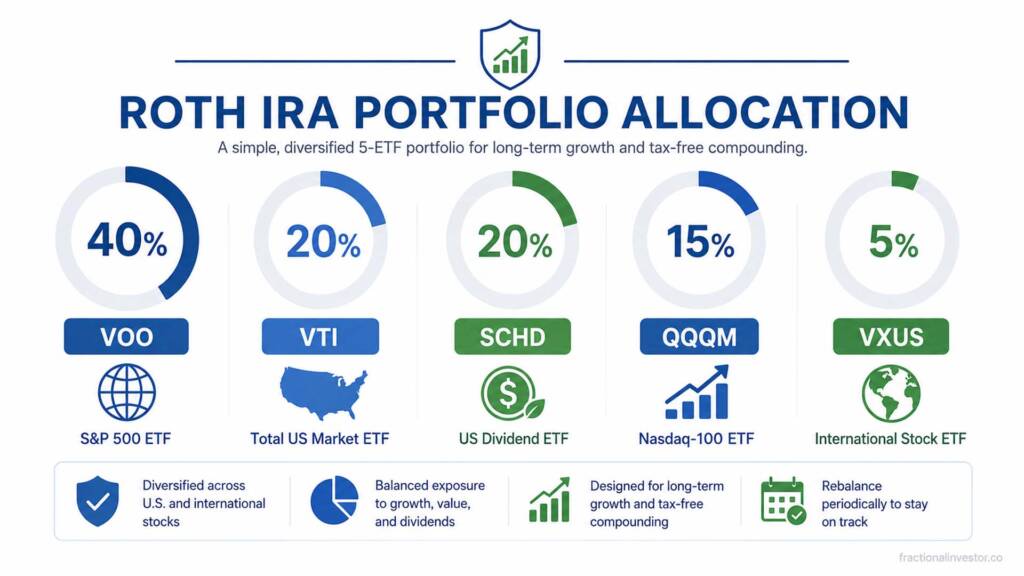
| ETF | Allocation | Purpose |
|---|---|---|
| VOO | 40% | Core S&P 500 stability |
| VTI | 20% | Broad market diversification |
| SCHD | 20% | Dividend income + stability |
| QQQM | 15% | Tech growth upside |
| VXUS | 5% | International diversification |
This 3-ETF portfolio strategy can be expanded to five ETFs for finer control. Adjust based on your risk tolerance:
- Conservative: 50% VOO, 25% SCHD, 15% VTI, 5% VXUS, 5% QQQM
- Aggressive: 30% VOO, 15% VTI, 10% SCHD, 35% QQQM, 10% VXUS
How to Open a Roth IRA and Buy These ETFs
Step 1: Choose a Brokerage
Open a Roth IRA at Vanguard, Fidelity, Charles Schwab, or Interactive Brokers (IBKR). All five ETFs are available at major brokerages.
Recommendation: Use Interactive Brokers (IBKR) for low fees, global access, and professional tools. International investors can also access U.S. markets through IBKR.
Step 2: Fund Your Account
Contribute up to $7,000 (2026 limit). Set up automatic monthly investments to practice dollar-cost averaging.
Step 3: Execute Your Purchase
Buy ETFs using the allocation above. For example, with $7,000:
- VOO: $2,800 (4 shares)
- VTI: $1,400 (4 shares)
- SCHD: $1,400 (43 shares)
- QQQM: $1,050 (3 shares)
- VXUS: $350 (4 shares)
Step 4: Rebalance Annually
Review your portfolio yearly and rebalance if allocations drift more than 5% from targets. Learn how often to rebalance for optimal results.
Common Roth IRA ETF Mistakes to Avoid
- Choosing High-Fee ETFs: A 1% fee vs. 0.03% steals thousands over 30 years. Avoid actively managed funds with fees above 0.50%.
- Overconcentrating in One Sector: Don’t put 50%+ in tech ETFs. Broad-market ETFs like VOO provide built-in diversification.
- Ignoring International Exposure: U.S. markets won’t always dominate. VXUS adds crucial global diversification.
- Picking Too Many ETFs: 5-7 ETFs is enough. More creates overlap and complexity without added benefit. Read about beginner investor mistakes to stay focused.
- Trying to Time the Market: Buy consistently regardless of market conditions. Learn what to do when the stock market crashes to maintain discipline.
Conclusion & Call to Action
The best ETF Roth IRA 2026 strategy combines VOO as your core, VTI for diversification, SCHD for income, QQQM for growth, and VXUS for international exposure. This five-ETF portfolio balances stability, growth, and diversification while keeping fees under 0.10% average.
Start with $50/month in VOO today. Over 30 years at 10% annual returns, that becomes $180,000+ tax-free. The math is undeniable—consistency beats complexity.
Ready to build your Roth IRA? Open an account at Interactive Brokers and start investing in these ETFs today.
What’s your current Roth IRA allocation? Share your portfolio in the comments below, or read our related guide on growth vs. dividend investing to refine your strategy.
FAQs
Q1: What is the single best ETF for a Roth IRA in 2026?
A1: VOO (Vanguard S&P 500 ETF) is the top choice due to its 27.95% past-year return, 0.03% expense ratio, and 500 large-cap company diversification. It serves as the essential core holding for most Roth IRA portfolios.
Q2: Can international investors open a Roth IRA and buy U.S. ETFs like VOO?
A2: Roth IRAs are only available to U.S. taxpayers with earned income. However, international investors can access U.S. ETFs through brokerages like Interactive Brokers. Learn more about VWRA vs. VOO for international investors.
Q3: How much should I invest monthly in my Roth IRA to reach $1 million?
A3: At 10% annual returns over 30 years, you need approximately $500/month. Use our FIRE calculator to customize this based on your timeline and expected returns.
Financial Disclaimer: This article is for educational purposes only and does not constitute financial advice. All investing involves risk, including loss of principal. Past performance does not guarantee future results. The ETFs mentioned (VOO, VTI, SCHD, QQQM, VXUS) are examples, not recommendations. Always consult with a licensed financial advisor before making investment decisions. Data sourced from public market information as of June 16, 2026.
