You’ve decided to invest in the S&P 500. Smart move. But then you open your brokerage app and face an immediate dilemma: VOO or SPY? Both track the same index. Both hold the same companies. Both have delivered nearly identical returns over the past decade. So why does the choice matter at all? Because over 20–30 years of compounding, even the smallest structural differences — fees, fund structure, dividend handling — quietly separate winners from nearly-winners. In 2026, with both ETFs sitting on impressive track records and the S&P 500 showing strong recovery, the VOO vs. SPY 2026 debate is worth settling once and for all. This guide gives you the data-driven answer you need to make the right call.
Key Takeaways:
- VOO charges 0.03% vs. SPY’s 0.0945% — VOO is approximately 3x cheaper, and that difference compounds into real money over decades
- VOO now manages ~$1.5 trillion in AUM vs. SPY’s ~$698 billion — VOO has surpassed SPY as the world’s largest ETF and offers strong liquidity for long-term investors
- SPY still dominates in trading volume — averaging ~81 million shares/day vs. VOO’s ~10 million — making it the preferred choice for active traders and options investors
What Are VOO and SPY?
Both VOO and SPY are passively managed exchange-traded funds that track the S&P 500 Index — the benchmark of America’s 500 largest publicly listed companies. Despite sharing the same index, they come from different fund families and carry different structural characteristics. Understanding those differences is the foundation of this entire comparison.
VOO — Vanguard S&P 500 ETF
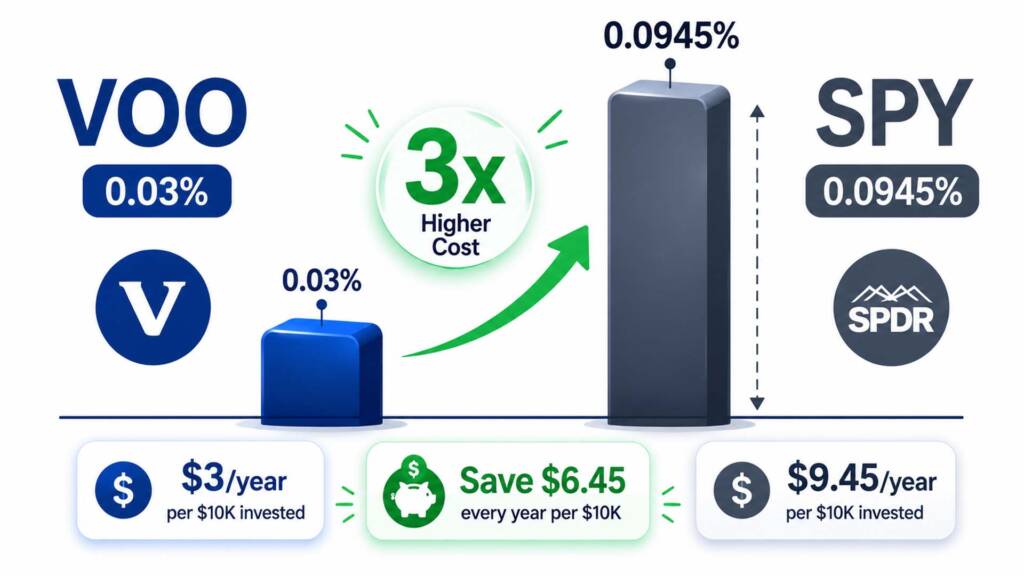
VOO was launched by Vanguard in 2010 and has since grown into the world’s largest ETF. As of early 2026, VOO manages approximately $1.5 trillion in assets under management (AUM). It carries an expense ratio of just 0.03% — meaning you pay $3 per year for every $10,000 invested. VOO is structured as a standard open-end mutual fund ETF, which gives it greater operational flexibility than SPY — including the ability to lend securities and reinvest dividends more efficiently.
Morningstar rates VOO with its top Gold Medalist Rating, citing its low fee structure and efficient index replication as key strengths. For a detailed look at building VOO as your portfolio foundation, see our dedicated guide on VOO as a core portfolio holding.
SPY — SPDR S&P 500 ETF Trust
SPY was launched by State Street (SPDR) in January 1993, making it the oldest ETF in the United States with over 33 years of history. That long track record gives institutional investors confidence and makes it the dominant vehicle for large-scale, short-term trading. As of March 2026, SPY manages approximately $698–$701 billion in AUM. However, it carries a higher expense ratio of 0.0945% — roughly 3x more expensive than VOO — due partly to its older Unit Investment Trust (UIT) structure, which limits its ability to reinvest dividends or lend securities between settlement dates.
Despite its higher fees, SPY earns Morningstar’s Silver Medalist Rating — still an excellent fund by any measure, but slightly behind VOO on overall efficiency.
VOO vs. SPY 2026: A Full Head-to-Head Comparison
Let’s cut straight to the numbers. Here is a comprehensive data comparison as of May 2026:
The returns are virtually identical — but every other metric favors one ETF over the other depending on your investing style.
The Expense Ratio Gap: Small Number, Big Impact
The most important number in this comparison is the 0.0645% fee gap between VOO and SPY. It sounds trivial. Over decades, it absolutely is not. Let’s simulate what that difference actually costs you:
Annual fee cost per $10,000 invested:
- VOO: $3.00/year
- SPY: $9.45/year
- Difference: $6.45/year — more than 3x higher with SPY
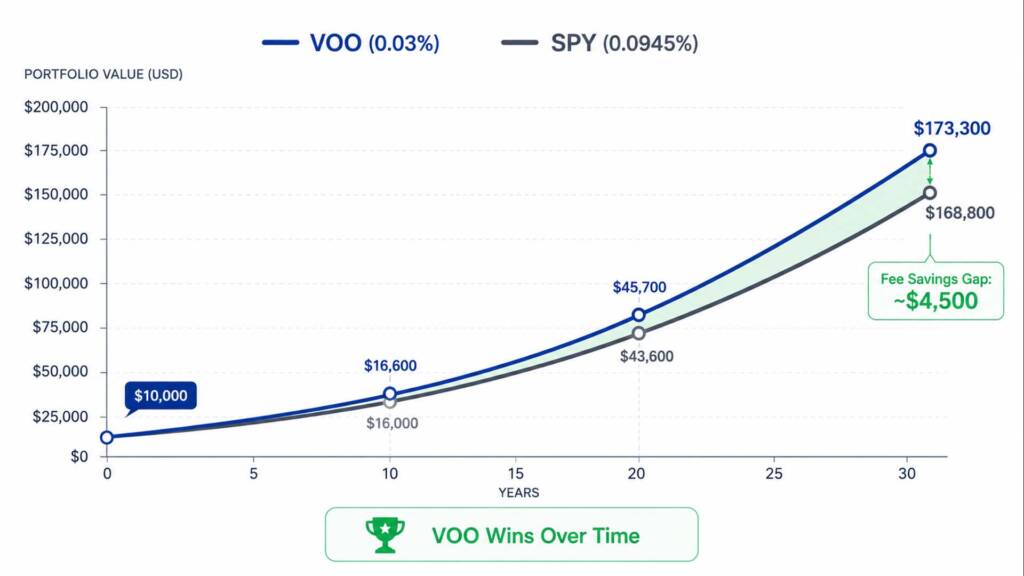
Now scale that up over a long-term investment horizon with a $10,000 initial investment, assuming both deliver the same 10% average annual gross return (based on historical S&P 500 averages):
| Time Horizon | VOO (0.03% fee) | SPY (0.0945% fee) | Difference |
|---|---|---|---|
| 10 Years | ~$25,870 | ~$25,700 | ~$170 |
| 20 Years | ~$66,980 | ~$65,760 | ~$1,220 |
| 30 Years | ~$173,300 | ~$168,800 | ~$4,500 |
These are projected outcomes based on historical averages — not guaranteed results. But the pattern is clear: the fee gap costs SPY holders thousands of dollars in unrealized compounding over a multi-decade horizon. If you’re investing $500/month rather than a single $10,000 lump sum, the difference grows even larger. This is why dollar-cost averaging into VOO specifically — rather than SPY — makes mathematical sense for the long-term accumulation investor.
Performance: Is There Actually a Difference?
Here’s the honest truth: in terms of raw performance, VOO and SPY are essentially identical. Both tracked a 1-year return of 17.3% as of February 2026 and 16.3% for the full year 2025. The S&P 500 index they both replicate delivered a 5-year growth of approximately $1,762 per $1,000 invested for VOO vs. $1,761 for SPY — a difference of just $1 over five years.
However, NerdWallet’s May 2026 data shows a subtle but consistent long-term edge for VOO: a 13.15% 10-year annualized return vs. SPY’s 13.09%. That 0.06% annual gap — compounded over decades — is essentially the expense ratio difference working quietly in VOO investors’ favor. Over 30 years, even a 0.06% annual performance edge turns into a meaningfully larger final portfolio balance.
Top Holdings: Nearly Identical
As of May 2026, both ETFs share the same top holdings, with technology dominating both funds:
- #1 — NVIDIA (NVDA)
- #2 — Apple (AAPL)
- #3 — Microsoft (MSFT)
- #4 — Amazon (AMZN)
- #5 — Alphabet (GOOGL)
Sector weights are also nearly identical, with technology at ~34–35%, financials at ~13%, and communication services at ~11%. For investors curious about whether to complement an S&P 500 core with a tech-tilted fund, our QQQ vs. VOO comparison explores that tradeoff in depth.
Liquidity: Where SPY Still Dominates
This is the one area where SPY wins by an enormous margin — and it matters for a specific type of investor.
SPY averages approximately 81 million shares traded per day, compared to VOO’s roughly 10 million shares per day. That makes SPY the single most liquid ETF on the planet. For active traders, institutional investors, and options traders, this liquidity is invaluable — tighter bid-ask spreads, faster execution, and massive options open interest make SPY the professional trader’s instrument of choice.
For the vast majority of long-term, buy-and-hold investors, however, this liquidity advantage is largely irrelevant. If you’re investing monthly via dollar-cost averaging and holding for 20+ years, you will never need to execute a trade at SPY’s speed or scale. VOO’s 10 million daily shares is more than sufficient liquidity for any retail investor — and its $1.5 trillion AUM actually gives it a strong institutional presence as well.
Fund Structure: Why It Actually Matters
Most investors overlook the structural difference between VOO and SPY — but it has real-world implications.
- VOO (Open-End ETF): Can reinvest dividends immediately upon receipt, reducing cash drag — the small performance loss from sitting in uninvested cash. It can also engage in securities lending to generate additional income that partially offsets its already-low expense ratio
- SPY (Unit Investment Trust): Must hold dividends in a non-interest-bearing cash account until the quarterly distribution date. This creates mild cash drag that slightly reduces compounding efficiency. Additionally, SPY cannot lend securities or reinvest dividends between distribution dates
This structural difference is the primary reason Morningstar upgraded VOO to Gold while keeping SPY at Silver in 2026. For long-term, compounding-focused investors, VOO’s open-end structure is the more efficient vehicle.
Who Should Choose VOO vs. SPY?
After reviewing all the data, the answer is straightforward for most investors:
Choose VOO If You Are:
- A long-term investor with a 10, 20, or 30+ year horizon
- Focused on minimizing fees and maximizing after-tax compounding
- A beginner or intermediate investor building a core passive portfolio
- Using a core and satellite portfolio strategy with VOO as your primary anchor
- Contributing regularly through dollar-cost averaging and reinvesting dividends
Choose SPY If You Are:
- An active trader who needs maximum liquidity for rapid execution
- An options trader who relies on SPY’s massive options market
- An institutional investor executing large block trades where spread efficiency matters
- Someone who needs the longest historical track record for backtesting purposes
For most readers of Fractional Investor, VOO is the clear winner — and not just marginally. The combination of the lowest expense ratio, the world’s largest AUM, Gold Morningstar rating, and superior fund structure makes it the definitive core holding for passive, long-term wealth building.
For authoritative external context, see Morningstar’s official 2026 analysis of VOO vs. SPY for a professional fund research perspective.
A Real-World Compounding Example
Let’s bring this home with a practical simulation for the everyday investor. Imagine you invest $200/month into either VOO or SPY starting in January 2026, earning a conservative 9% average annual return (below the S&P 500’s historical ~10–12% average):
| Period | VOO ($200/month, 9% return) | SPY ($200/month, ~8.91% after fee gap) |
|---|---|---|
| 5 Years | ~$14,930 | ~$14,870 |
| 10 Years | ~$38,570 | ~$38,180 |
| 20 Years | ~$133,070 | ~$131,080 |
| 30 Years | ~$368,000 | ~$360,900 |
These are projected outcomes only — not guaranteed. But over 30 years, the fee gap alone could cost a $200/month SPY investor approximately $7,100 in unrealized compounding compared to VOO — simply for paying an extra 0.0645% per year. That’s not pocket change. That’s a vacation, a car payment, or years of additional monthly contributions simply lost to an avoidable fee.
If you’re just starting out and wondering how far even $50/month can go, our article on investing $50 a month in VOO will show you what consistent contributions can build over time.
Conclusion & Call to Action
The VOO vs. SPY 2026 debate has a clear winner for the typical long-term, passive investor: VOO. With a 3x lower expense ratio, $1.5 trillion in AUM, a Gold Morningstar rating, and a superior open-end fund structure, VOO is simply the more efficient vehicle for building wealth over decades. SPY remains an excellent instrument — but its true home is on a trading desk, not a retirement account.
The best time to invest in the right ETF was ten years ago. The second-best time is today. Start with VOO as your core, apply disciplined dollar-cost averaging, and let time and compounding do the heavy lifting.
Which ETF are you currently holding — VOO or SPY? Drop a comment below and tell us why. And if you’re still weighing your overall portfolio structure, don’t miss our guide on how often to rebalance your portfolio to keep your S&P 500 core in perfect shape long-term.
Frequently Asked Questions
Q1: Is VOO better than SPY for a long-term buy-and-hold investor in 2026?
A1: Yes — for long-term, buy-and-hold investors in 2026, VOO is the better choice. It carries a 0.03% expense ratio vs. SPY’s 0.0945%, manages $1.5 trillion in AUM, and holds Morningstar’s top Gold Medalist Rating. Both ETFs track the identical S&P 500 index and deliver virtually the same gross returns — but VOO’s lower fees and superior open-end fund structure result in slightly better net compounding over multi-decade horizons.
Q2: Why does SPY have a higher expense ratio than VOO if they track the same index?
A2: SPY charges a higher fee primarily because of its older Unit Investment Trust (UIT) legal structure, established when it launched in 1993. This structure limits its operational flexibility — it cannot reinvest dividends immediately or engage in securities lending to offset costs, unlike VOO’s open-end ETF structure. Additionally, State Street has historically maintained SPY’s fee as a premium for its unmatched liquidity and institutional brand recognition among active traders and options investors.
Q3: Can I switch from SPY to VOO without paying too much in taxes?
A3: Switching from SPY to VOO in a taxable brokerage account will likely trigger a capital gains tax event on any unrealized profit you’ve accumulated in SPY. If you’ve held SPY for more than 12 months, those gains qualify for the lower long-term capital gains rate (0%, 15%, or 20% depending on your income). However, if you hold SPY inside a tax-advantaged account like an IRA or 401(k), you can switch to VOO with no tax consequences whatsoever. For most long-term investors, the transition is worth it — but consult a tax professional for guidance specific to your situation.
Financial Disclaimer: This article is intended for educational and informational purposes only. It does not constitute financial, investment, tax, or legal advice. All performance figures, returns, and fee comparisons cited are based on publicly available data and historical records, which do not guarantee future results. Individual investment outcomes will vary based on timing, contribution amounts, tax situation, and market conditions. Always consult a licensed financial advisor before making any changes to your investment portfolio.