You want exposure to the Nasdaq-100’s biggest growth names, so you start researching and immediately hit a wall: two nearly identical tickers, QQQ and QQQM, both from Invesco, both tracking the same index. Pick the wrong one, and you could quietly overpay in fees for decades or end up holding a fund that doesn’t fit your trading style. That confusion is exactly why so many beginner and intermediate investors ask the same question every year. This guide breaks down the QQQ vs QQQM difference in plain English, using real 2026 pricing, fees, and performance data, so you can choose with confidence.
Key Takeaways:
- QQQ and QQQM track the identical Nasdaq-100 Index, so their holdings and gross returns are virtually the same before fees.
- QQQM charges a lower 0.15% expense ratio versus QQQ’s 0.18%, while QQQ offers deeper liquidity, a lower share price relative to its size, and a robust options market.
- For most beginner and long-term buy-and-hold investors, QQQM is usually the more cost-efficient core pick, while QQQ better suits active traders and options strategies.

What Is QQQ? A Quick Overview
Invesco QQQ Trust launched all the way back in 1999, making it one of the oldest and most heavily traded ETFs in the world. It tracks the Nasdaq-100 Index, which holds 100 of the largest non-financial companies listed on the Nasdaq exchange.
As of mid-June 2026, QQQ trades around $740 per share, manages roughly $493 billion in assets, and carries a total expense ratio of 0.18%. The fund has posted a year-to-date gain of about 20.7% so far in 2026, reflecting continued strength in mega-cap technology names.
Because QQQ launched as an original unit investment trust, it has built up enormous trading volume and an extensive listed options market. Consequently, professional traders, institutions, and options sellers gravitate toward QQQ specifically because of that liquidity.
What Is QQQM? The “Mini” Version Explained
Invesco launched QQQM in October 2020 to serve a different type of investor. Instead of competing on trading volume, QQQM was designed from day one to be a low-cost, buy-and-hold companion fund.
QQQM tracks the exact same Nasdaq-100 Index as QQQ, holding the same roughly 100 companies in the same weightings. As of mid-June 2026, QQQM trades near $303 per share, with assets under management around $101 billion and an expense ratio of just 0.15%.
Because the share price sits well below QQQ’s, QQQM has historically appealed to investors who buy whole shares rather than fractional shares. Today, with fractional-share investing available at most brokerages, that price gap matters less than it once did, but the fee gap still matters a great deal.
Breaking Down the QQQ vs QQQM Difference: Side-by-Side Comparison
Now let’s get into the real QQQ vs QQQM difference that actually affects your returns. The two funds are similar on the surface, but several structural details separate them in meaningful ways.
Expense Ratio: Why 0.03% Matters Over Time
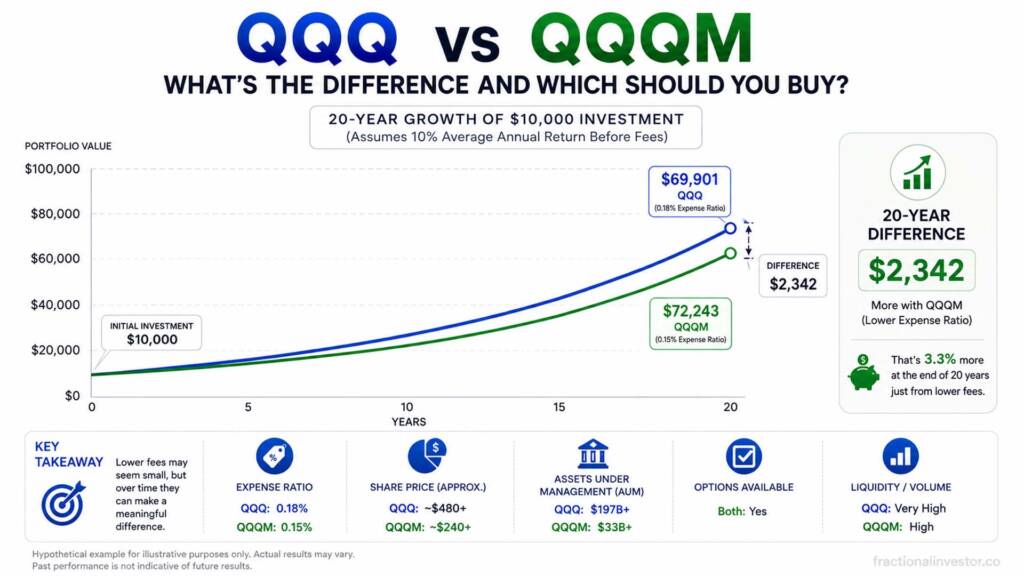
QQQ charges 0.18% annually, while QQQM charges 0.15%. That 0.03 percentage-point gap sounds tiny, and on a small account, it is.
However, fees compound. On a $400,000 portfolio, that 0.03% difference equals about $120 per year in extra cost for QQQ holders, every single year, indefinitely. Over a multi-decade investing horizon, that steady annual drag adds up to a noticeably larger gap, which we’ll calculate below.
Share Price and Accessibility
QQQ’s higher share price near $740 once meant smaller investors needed more capital to buy a single share. QQQM’s lower price near $303 made it more approachable for beginners contributing smaller amounts each month.
Most major brokerages, including Interactive Brokers, now support fractional shares, so this gap matters far less than it did in 2020. Still, if your brokerage doesn’t support fractional investing, QQQM’s lower price point remains genuinely useful.
Liquidity and Trading Volume
QQQ is one of the most actively traded securities on the planet, with daily volume in the tens of millions of shares. QQQM trades far less frequently, with average daily volume closer to five million shares.
For long-term buy-and-hold investors making periodic purchases, this liquidity gap is largely irrelevant. Active traders moving large blocks of shares intraday, however, will get tighter bid-ask spreads with QQQ.
Options Availability
QQQ has one of the deepest, most liquid listed options markets in the entire ETF universe. Traders use QQQ options for hedging, income generation through covered calls, and leveraged directional bets.
QQQM does not currently offer a comparably developed options chain. If your strategy depends on options trading, QQQ remains the only realistic choice between the two.
A Real Numbers Simulation: The 20-Year Cost of the Fee Gap
Let’s run a simple, hypothetical simulation to see how that 0.03% fee gap actually plays out. Suppose an investor contributes $500 per month into either fund for 20 years, and both funds happen to deliver an identical hypothetical 10% average annual gross return before fees, since they track the same index.
After accounting for each fund’s expense ratio, here is the projected outcome:
- QQQ (0.18% fee): Net return of roughly 9.82% annually, growing to approximately $351,500 after 20 years.
- QQQM (0.15% fee): Net return of roughly 9.85% annually, growing to approximately $357,500 after 20 years.
That’s a projected difference of about $6,000, purely from the lower expense ratio, assuming identical contributions and identical underlying index performance. This is a hypothetical projection for illustration only, not a guaranteed or promised return. Still, it demonstrates why fee discipline matters so much for long-term, buy-and-hold investors. For a deeper look at how compounding habits build wealth over time, see our guide on the dividend snowball effect.
Performance Comparison: Do Returns Actually Differ?
Because QQQ and QQQM hold identical underlying companies, their gross performance is essentially the same year to year. As of mid-June 2026, QQQ has gained about 20.7% year-to-date, while QQQM has gained a comparable 20.6%, with the tiny gap explained by fee drag and rounding.
Both funds remain heavily concentrated in mega-cap technology and communication-services names. If you’re weighing this growth-heavy approach against a more balanced approach, our article on QQQ vs SCHG in 2026 compares Nasdaq-100 exposure to a broader large-cap growth index.
Which Should You Buy? QQQ vs QQQM for Different Investor Types
There’s no universal right answer here. The better choice genuinely depends on how you invest, not just which ticker is “better” on paper.
Best for Beginners and Long-Term Investors
If you’re dollar-cost averaging every month, reinvesting dividends, and not trading actively, QQQM is usually the smarter pick. The lower 0.15% expense ratio compounds in your favor over years, and you don’t need QQQ’s options liquidity if you’re never trading options.
Remember, though, that broad-market funds like VOO are generally considered the more stable, foundational core holding for most long-term portfolios, with QQQ or QQQM playing more of a growth-oriented satellite role. If you’re still building your foundational knowledge, our beginner’s guide to ETF investing is a great starting point.
Best for Active Traders and Options Strategies
If you trade frequently, write covered calls, or use options for hedging, QQQ is the practical choice. Its deeper liquidity and mature options chain simply aren’t matched by QQQM today.
Tax Accounts: Roth IRA vs Taxable Brokerage
Inside a Roth IRA, the lower-fee QQQM often makes more sense, since you’re optimizing for long-term, tax-free compounding with minimal trading. Our guide on the best ETFs for a Roth IRA in 2026 digs deeper into account-specific ETF selection.
In a taxable brokerage account where you might use options for tax-loss harvesting or hedging, QQQ’s flexibility can be the more practical fit. If you’re opening a new brokerage account to access either fund, Interactive Brokers offers commission-free trading on both QQQ and QQQM shares.
How QQQ and QQQM Fit Into a Diversified Portfolio
Neither QQQ nor QQQM should typically serve as your entire portfolio, since both are concentrated in a single index sector profile. Many investors pair one of these funds with a broad-market core holding like VOO to balance growth potential with diversification.
For a direct comparison of Nasdaq-100 exposure against the broader S&P 500, read our breakdown of QQQ vs VOO. According to Invesco’s own official QQQ fund page, the ETF has outperformed the S&P 500 in seven of the last ten years through March 2026, though Invesco is careful to note that double-digit, high-growth stretches like this one are historically unusual and shouldn’t be expected to continue indefinitely.
It’s also worth factoring in the current macro backdrop. As of the Federal Reserve’s June 2026 meeting, the federal funds rate remains held at 3.50%–3.75%, with policymakers now signaling a possible rate hike later this year rather than the cuts markets expected earlier. Elevated rates and inflation pressure can weigh on high-growth, high-valuation names like those inside the Nasdaq-100, so position-sizing your QQQ or QQQM allocation thoughtfully alongside more defensive holdings remains a smart practice in 2026.
Conclusion & Call to Action
The real QQQ vs QQQM difference boils down to cost versus liquidity, not better versus worse performance, since both funds track the identical Nasdaq-100 Index. If you’re a long-term, buy-and-hold investor focused on minimizing fees, QQQM’s 0.15% expense ratio likely makes it your better core growth holding. If you actively trade or rely on options strategies, QQQ’s unmatched liquidity is hard to replace.
Which fund fits your strategy better? Drop a comment below and let us know whether you’re Team QQQ or Team QQQM. For more on building a complete, balanced portfolio around your growth holdings, check out our guide to the 70/30 VOO/SCHD portfolio strategy.
FAQs
Q1: Is QQQM better than QQQ for long-term investing? A1: For most long-term, buy-and-hold investors, QQQM’s lower 0.15% expense ratio versus QQQ’s 0.18% typically makes it the more cost-efficient choice, since both funds track the identical Nasdaq-100 Index and deliver essentially the same gross returns.
Q2: Can I convert my QQQ shares to QQQM without triggering taxes? A2: No, swapping QQQ for QQQM is treated as a taxable sale and purchase in a standard brokerage account, so consult a tax professional before converting; inside a Roth or traditional IRA, there’s no tax event to worry about.
Q3: Does QQQM pay dividends like QQQ does? A3: Yes, both funds distribute dividends quarterly from the underlying companies’ payouts, and because QQQM’s expense ratio is lower, its dividend yield is typically a few basis points higher than QQQ’s after fees.
Financial Disclaimer: This article is for educational and informational purposes only and does not constitute personalized financial, investment, or tax advice. All performance figures, prices, and projections referenced are based on publicly available data as of June 2026 and are subject to change. Past performance does not guarantee future results. Always consult a licensed financial advisor before making any investment decisions.