You watch the news. Inflation is back above 4%. The Fed just held rates steady — again — while hinting at possible hikes later this year. The S&P 500 had a rocky start to 2026 before staging a sharp recovery. And now you’re sitting there wondering: Is it a good time to buy ETFs in June 2026 — or should I just wait on the sidelines?
Here’s the uncomfortable truth. Waiting for the “perfect time” to invest is one of the costliest mistakes retail investors make. Markets don’t ring a bell at the bottom. What they do reward, consistently and historically, is disciplined, long-term participation. If you’ve been hesitating, this article breaks down exactly where the market stands in June 2026, what the data says, and whether ETFs belong in your portfolio right now.
Key Takeaways:
- The S&P 500 is up approximately 8–10% year-to-date in 2026, recovering from a sharp Q1 correction, which means patient investors who stayed the course have already been rewarded.
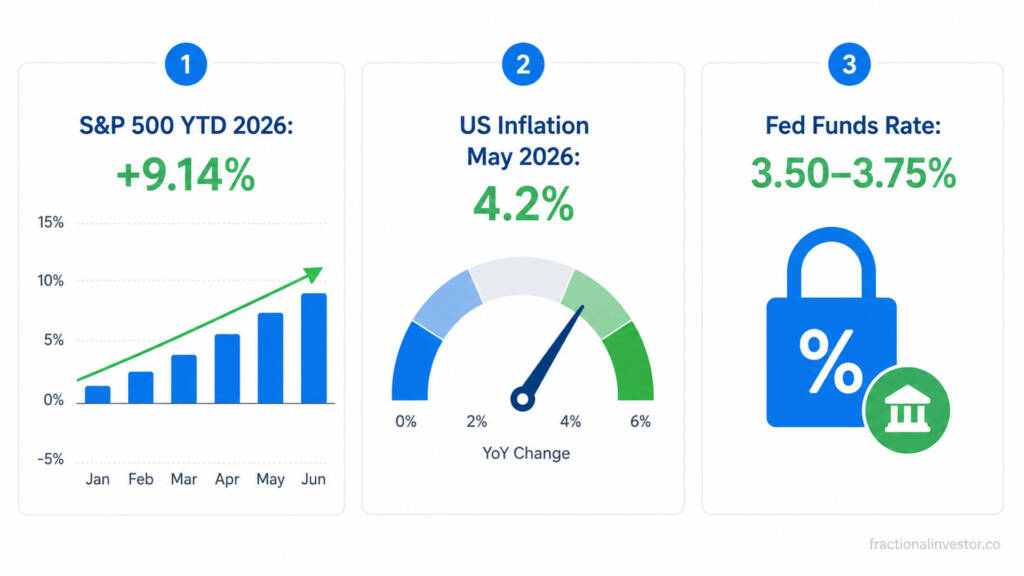
- VOO, the benchmark S&P 500 ETF, is trading around $689, up +9.14% year-to-date as of mid-June 2026 — making it a solid core holding for long-term investors.
- Dollar-cost averaging (DCA) remains the most effective strategy in a volatile, high-inflation environment, eliminating the need to “time the market.”
Where the Market Stands in June 2026
Before you decide whether it’s a good time to buy ETFs in June 2026, you need to understand the current macro backdrop. Three key forces are shaping the investment landscape right now.
The S&P 500 Recovery Is Real — But Fragile
The S&P 500 took a significant hit in early 2026. By the end of Q1, the index had fallen approximately -4.34% from its year-end 2025 levels. However, it staged a powerful comeback. By mid-June, the index had climbed back to trade around the 7,420–7,554 range, representing roughly a 8–10% gain year-to-date. The Nasdaq composite has outperformed even more sharply, rising approximately +14.8% year-to-date by mid-June.
This recovery demonstrates a critical truth about broad-market ETFs: they are designed to weather drawdowns and bounce back. The S&P 500 is up over 25% compared to the same period last year. For long-term ETF investors, corrections are not disasters — they are discounts.
Inflation Is Elevated, But Core Prices Are Cooling
US inflation climbed to 4.2% annually in May 2026 — the highest reading in more than three years. This is above the Fed’s 2% target and has complicated the rate-cut narrative. However, core inflation (excluding food and energy) remains at 2.9%, which is meaningfully lower. This divergence matters because it suggests that headline inflation is being driven by volatile commodity and energy prices, not a broad, structural re-acceleration.
For ETF investors, elevated inflation is actually a reason to invest, not a reason to stay in cash. Cash loses purchasing power at 4.2% per year. A broad-market ETF like VOO has delivered an annualized return of +14.24% since inception. The math strongly favors staying invested.
The Fed Is On Hold — For Now
On June 17, 2026, the Federal Open Market Committee (FOMC) voted unanimously to hold the federal funds rate at 3.50%–3.75% for the fourth consecutive meeting. However, the Fed’s dot-plot projections reveal that nearly half of policymakers now expect at least one rate hike by year-end 2026. New Fed Chair Kevin Warsh is balancing growth support against the persistent inflation overshoot.
For ETF investors, a “higher for longer” rate environment historically favors dividend ETFs and quality-factor ETFs alongside growth-oriented broad-market funds. It also means that bond ETFs are starting to offer meaningful real yields again — something not seen in years.
Why ETFs Are Still the Best Vehicle in 2026
The fundamental case for ETFs has not changed. In fact, the 2026 environment makes them even more compelling for retail investors.
Broad Diversification Reduces Individual Stock Risk
When you buy a single stock, you take on the risk of one company. When you buy VOO, you own a stake in 500 companies simultaneously. In June 2026, sector performance has been highly divergent — Chip Equipment stocks are up +17.9% while Enterprise Software is down -26.0% within the same month. An investor holding individual tech stocks got hurt. An ETF investor owning the whole market smoothed that pain significantly.
This is exactly the kind of environment where diversification pays. No one can consistently predict which sectors will rotate in or out of favor. Broad-market ETFs like VOO and VTI remove the need to guess. If you’re new to ETF investing, our guide on What Is ETF Investing explains the mechanics from the ground up.
Low Costs Compound Into Massive Long-Term Gains
VOO carries an expense ratio of just 0.03% per year. That’s $0.30 per year on a $1,000 investment. Compare that to actively managed mutual funds, which average 0.5%–1.0% annually. Over 30 years, that difference in fees can represent tens of thousands of dollars in lost returns due to compounding. The math is not subtle — it’s decisive.
Historical Returns Support Long-Term Optimism
Despite all the short-term noise, the long-term track record of index ETFs is extraordinary:
- VOO has delivered an annualized return of +14.24% since inception.
- The S&P 500 has returned an average of approximately +10% per year over the long run, including dividends.
- QQQ (Nasdaq-100 ETF) is up +16.75% year-to-date as of early June 2026 and has delivered a staggering +40.66% total return over the past 12 months.
Past performance does not guarantee future results. However, these historical returns give long-term investors a rational basis for confidence.
The Best ETFs to Consider in June 2026
If you’ve concluded that now is a reasonable time to invest, the next question is: which ETFs? Here’s a framework based on investor goals.
For Core, Broad-Market Exposure: VOO
VOO — the Vanguard S&P 500 ETF — is the undisputed cornerstone of a long-term portfolio. As of June 18, 2026, VOO trades at approximately $689 per share. Its year-to-date return stands at +9.14%, with a trailing 12-month return of +25.63%. VOO should represent the core of virtually every retail investor’s ETF portfolio. Read our deep-dive: VOO ETF as Your Core Portfolio Holding.
For a comparison of VOO vs. its major rivals, check out VOO vs. SPY in 2026 and QQQ vs. VOO.
For Growth Tilted Exposure: QQQ
QQQ tracks the Nasdaq-100, the 100 largest non-financial companies on the Nasdaq. It is up +16.75% year-to-date as of early June 2026. QQQ is more volatile than VOO — it fell harder in Q1 and rebounded more sharply. It is best suited for investors with a higher risk tolerance and a long time horizon, positioned as a satellite holding alongside a VOO core. See our analysis in 3 ETF Portfolio Strategy.
For Dividend Income: SCHD
SCHD — the Schwab US Dividend Equity ETF — offers a current dividend yield of approximately 3.3–3.97%, making it one of the most attractive income-generating ETFs available. Its total return over the past year has been +23.95%. However, SCHD has underperformed the broader market in 2026 year-to-date at just +2.34%, reflecting the market’s current preference for growth over value. For income-focused investors, SCHD remains a cornerstone of a passive income strategy. Explore our full breakdown in SCHD ETF Review 2026.
For a detailed comparison of dividend ETFs, see SCHD vs. DGRO 2026 and SCHD vs. JEPI.
ETF Quick Comparison — June 2026
| ETF | Focus | YTD Return | Expense Ratio | Dividend Yield |
|---|---|---|---|---|
| VOO | S&P 500 (Broad) | +9.14% | 0.03% | ~1.02% |
| QQQ | Nasdaq-100 (Growth) | +16.75% | 0.20% | ~0.6% |
| SCHD | US Dividend Quality | +2.34% | 0.06% | ~3.97% |
The Power of Dollar-Cost Averaging in a Volatile Market
One of the most important strategies for the current environment is dollar-cost averaging (DCA) — investing a fixed dollar amount at regular intervals regardless of price. This approach is especially powerful in 2026, when volatility remains elevated and the VIX has frequently traded above 22–25.
A Simple DCA Simulation
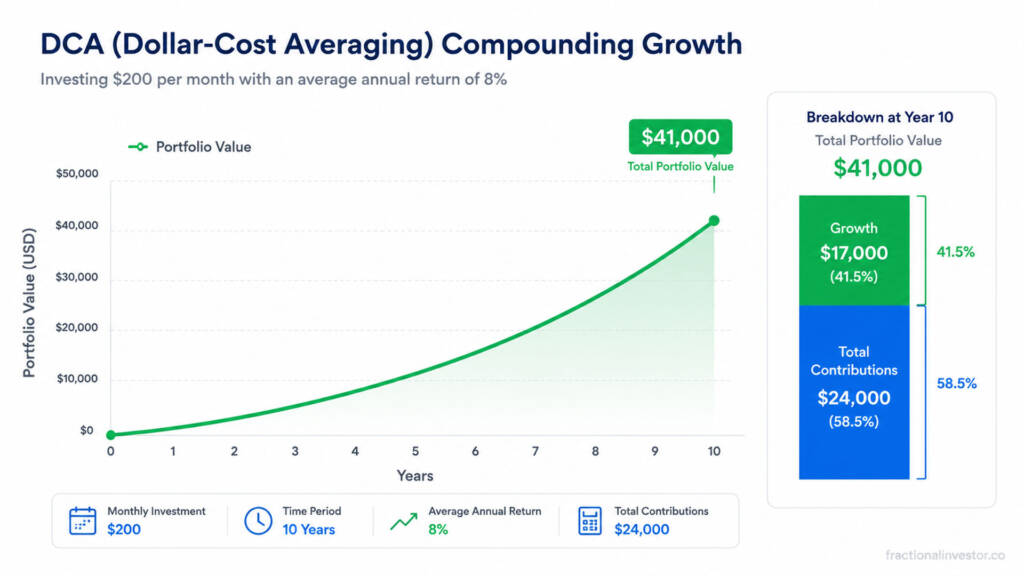
Consider this realistic example using VOO’s historical 10% average annualized return:
- Monthly investment: $200
- Time horizon: 10 years
- Historical average return assumption: ~10% annually
After 10 years, your total contributions would be $24,000. With compounding at 10% annually, your projected portfolio value would reach approximately $41,000 — a gain of roughly $17,000 without any active stock-picking or market timing.
Now extend that to 20 years at the same rate:
- Total contributions: $48,000
- Projected portfolio value: ~$153,000
This is the compounding effect at work. The longer you invest, the more powerful it becomes. DCA also removes the psychological burden of trying to “time the bottom.” For a complete guide on this strategy, read Dollar-Cost Averaging Explained.
Even investing $50 per month into VOO has historically demonstrated meaningful wealth-building power over time. See our simulation in Investing $50 a Month in VOO.
Why Consistency Beats Timing
In 2026, the market swung from -4.34% in Q1 to +9% by mid-June. Investors who paused their DCA contributions during the Q1 fear missed one of the sharpest recoveries of the year. Furthermore, the current 3.5%+ money market yields mean that cash waiting on the sidelines still earns something — but it cannot compound the way equity ETFs do over 10–20 years.
Want to take your automation to the next level? Read our guide on How to Automate Your ETF Investment Strategy.
Key Risks to Watch in the Second Half of 2026
Investing in ETFs right now does carry real risks. Acknowledging them helps you invest with eyes open.
Risk 1: A Potential Fed Rate Hike
Nine FOMC members now project at least one rate hike by year-end 2026. If the Fed raises rates from 3.75% to 4.0%, it could trigger a risk-off selloff in equities, particularly in growth and tech-heavy ETFs like QQQ. Bond ETF prices would also fall in the short term. Investors should mentally prepare for this scenario and avoid over-leveraging.
Risk 2: Inflation Re-Acceleration
The May 2026 CPI reading of 4.2% — the highest in three years — surprised many analysts who expected prices to moderate. If geopolitical tensions (particularly in the Middle East, which have already been a factor in energy prices) push commodity prices higher, inflation could re-accelerate. This would extend the “higher for longer” rate environment and compress equity valuations.
Risk 3: Sector Rotation Volatility
As seen in June 2026, sector performance has been extremely divergent. ETFs concentrated in Enterprise Software (-26%) or Cybersecurity (-12%) have suffered. Broad-market ETFs reduce this risk, but sector or thematic ETFs carry meaningful concentration danger. Stick to diversified, low-cost index ETFs for your core holdings.
To understand what to do if the market sells off sharply, read What to Do When the Stock Market Crashes.
Building a Portfolio Around ETFs in 2026
The most resilient approach to ETF investing in the current environment is the core-and-satellite framework.
- Core (60–70%): A broad-market ETF like VOO provides the stable foundation. It tracks the S&P 500, benefits from every market recovery, and costs almost nothing in fees.
- Satellite — Growth (15–20%): QQQ or SCHG adds a growth tilt to capture tech sector outperformance.
- Satellite — Income (10–15%): SCHD or JEPI provides dividend income and acts as a portfolio stabilizer.
For a deep dive on this framework, see our article on Core and Satellite Portfolio Strategy.
You can also explore platforms like Interactive Brokers (IBKR) to start building your ETF portfolio with access to all major US-listed ETFs at competitive commission rates. Additionally, sites like Investopedia’s ETF Guide and Vanguard’s research hub provide excellent independent educational resources to deepen your knowledge.
If you’re investing toward financial independence, run your numbers through our FIRE Calculator to see how your ETF portfolio can accelerate your path to early retirement. You can also read our dedicated article on FIRE Strategy and ETF Investing.
For investors primarily focused on generating passive income from dividends, explore our guides on Building a Dividend Portfolio in 2026 and Passive Income ETF Portfolio.
Conclusion & Call to Action
So, is it a good time to buy ETFs in June 2026? The data gives a clear answer: yes — with discipline. The S&P 500 has staged a strong recovery from its Q1 lows, VOO trades at approximately $689 with a +9.14% YTD gain, and long-term compounding math decisively favors consistent monthly investing over cash-sitting. Inflation is elevated, and a Fed rate hike is possible — but these are reasons to invest in quality, diversified ETFs, not reasons to avoid the market entirely.
The investors who build wealth are not the ones who wait for certainty. They are the ones who invest consistently through uncertainty and let time do the work.
Are you currently investing in ETFs, or still on the sidelines? Drop a comment below and let us know your strategy — or share which ETF you’re adding to your portfolio in June 2026. Also, check out our related article: Growth vs. Dividend Investing — Which Is Right for You?
FAQs
Q1: Is it a good time to buy ETFs in June 2026 given high inflation?
A1: Yes, it is generally still a good time to invest in broad-market ETFs like VOO even with inflation at 4.2%. Cash loses purchasing power in a high-inflation environment, while VOO has delivered a +14.24% annualized return since inception. Broad-market ETFs historically outpace inflation over 10+ year horizons, making them one of the best long-term hedges against purchasing power erosion.
Q2: Should I wait for the Fed to cut rates before buying ETFs?
A2: Waiting for rate cuts is a form of market timing, and it typically backfires. As of June 2026, the Fed is holding rates at 3.50%–3.75% and may even hike later in the year. History shows that stock markets have delivered strong returns in both rising-rate and falling-rate environments. The more important factor is time in the market, not timing the market.
Q3: Which ETF is the best to buy right now in June 2026 for a beginner?
A3: For most beginners, VOO (Vanguard S&P 500 ETF) is the single best starting point. It trades around $689, carries a 0.03% expense ratio, and is up +9.14% year-to-date. It provides instant diversification across 500 major US companies at the lowest possible cost. For a structured beginner’s approach, avoid these common beginner investor mistakes that derail portfolios early on.
Financial Disclaimer: This article is for educational and informational purposes only. Nothing in this article constitutes financial, investment, or tax advice. All investment data referenced reflects market conditions as of June 2026 and is subject to change. Past performance is not indicative of future results. Always conduct your own research and consult with a licensed financial advisor before making any investment decisions. Investing involves risk, including the possible loss of principal.